USAID DEC
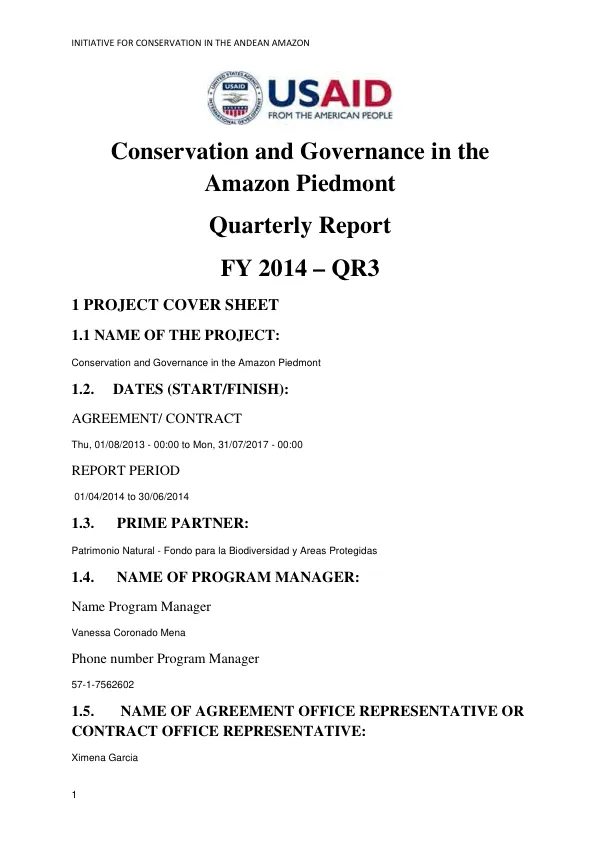
Initiative for Conservation in the Andean Amazon: Conservation and Governance in the Amazon Piedmont
Sign inUSAID
Initiative for Conservation in the Andean Amazon: Conservation and Governance in the Amazon Piedmont
The Conservation and Governance in the Amazon Piedmont initiative began in 2013 with funding from USAID's Food Security Program.
2014 · 6 pages
Sign in to readA free account is required to download.
Abstract
The project aims to integrate a landscape management approach to maintain the integrity of ecosystems in the Amazon Piedmont while promoting sustainable economic development. The initiative focuses on three departments in Colombia: Caquetá, Putumayo, and Cauca. Component 1 of the project involves improving production systems by enhancing continuity in the provision of ecosystem services, linking market aspects in value chain analysis, and implementing economic incentives and mechanisms for scaling-up solutions. Component 2 focuses on building a landscape-wide planning and zoning strategy to promote ecological connectivity and existing ecological networks. Component 3 aims to strengthen institutions, grassroots organizations, and sectorial stakeholders through a strategy that creates informed and coordinated actions focused on improving land use planning, agreements on land use, and compensation offsets. During the third quarter of 2014, the SINCHI Institute conducted socialization sessions with local communities in San José del Fragua, focusing on agroforestry activities. The institute also evaluated farm planning documents delivered by the National Natural Park Alto Fragua Indi Wasi to identify advancements in the farm planning process and forests areas located in each village. Additionally, the SINCHI Institute conducted a social assessment of local organizations, such as ASOHECA, ACAMAFRUT, and community organizations, to define capacities that need to be strengthened in each organization as part of the activities for the agroforestry activity. The CIPAV technical team carried out socialization processes with various entities, including the Caquetá local government, Nestlé, and the Livestock committee of Belén de los Andaquíes, to promote silvopastoral activities. As a result, CIPAV started negotiations with Nestlé to sign an agreement that would include some beneficiaries of the C&G program as providers of Nestle. The agreement would benefit the project by securing commercialization, providing a premium price for milk, and offering extra technical assistance. The main challenges identified during the third quarter were related to the socialization of the silvopastoral activity with local communities, which was postponed due to a delay in the socialization process with local livestock committees and other producers. To overcome this situation, CIPAV obtained a list of potential beneficiaries to start the selection of farms to be visited and defined clusters of socialization in the villages. The Environmental and Socio-economic assessment for the intervention area of the Water and Soils Conservation District (WSCD) began during this period. FPN consolidated the team that will be in charge of the coordination activities at a local level, drafted a final proposal for the training scheme regarding land use and biodiversity, and created a matrix with environmental and biophysical information available for the area of the WSCD. The team also socialized the activity with local governments, Corpoamazonía, and local communities, and held technical meetings with Corpoamazonía and local governments to formalize the technical commission towards the preparation of the planning proposal for the WCSD.
Related documents