USAID
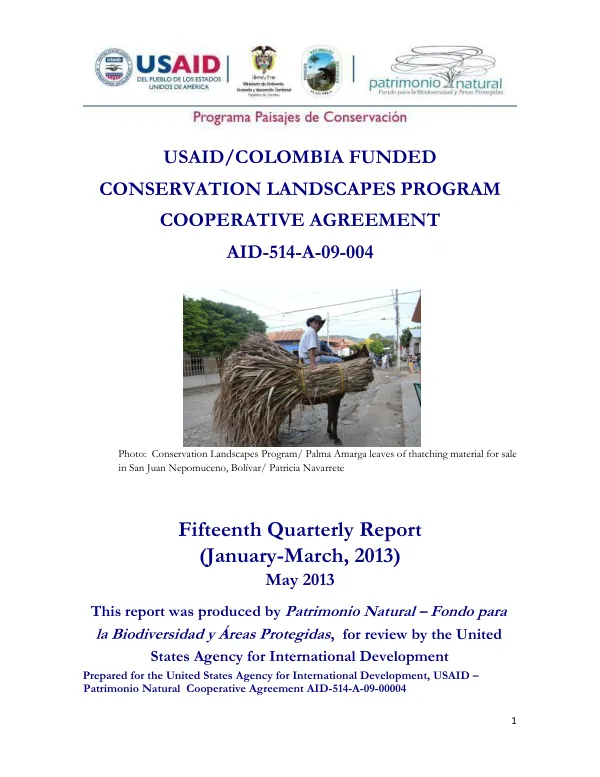
Fifteenth Quarterly Report: Conservation Landscapes Program
The Conservation Landscapes Program in Colombia began implementing activities in 2013, focusing on sustainability strategy and conservation efforts.
2013 · 33 pages
Sign in to readA free account is required to download.
Abstract
The program's main objective is to promote the conservation of natural resources and biodiversity in the country. The program is funded by the United States Agency for International Development (USAID) and is implemented by Patrimonio Natural – Fondo para la Biodiversidad y Áreas Protegidas. During the reporting period, the program's activities were mainly related to the sustainability strategy, which includes the implementation of solar energy solutions for indigenous villages in the Sierra Nevada de Santa Marta Park. Equipment was acquired, and some of it was delivered to the villages, with the first phase of construction initiated. The local operator, Fundación Tropenbos, continued their capacity building process in Katíos, strengthening management skills and collective agreements for the beginning of their small enterprise. The program also provided technical assistance to campesinos and indigenous people in La Lengueta, Sierra Nevada de Santa Marta Park, to consolidate sustainable production established over the last two years. Members of the Parks' community communication team systematized results in Utría, Cocuy, and Orito, and recorded additional music in the Caribbean Parks' zone of influence. A diagnostic for agro-ecological potential in the Caribbean was begun with a regional characterization, using a participative method to assess the situation in each of three nodes and design the project according to local needs and context. Two potential biological connectivity corridors were selected in the zone of influence of the Colorados FFS, and field tours were carried out with the support of park staff, local experts, and communities. Workshops were conducted in the Pintura, Páramo, and Loro veredas, where maps of the areas were made with local people, checking against a previous socioeconomic study made for 300 farms in the area. The potential for connectivity through agroforestry and silvo-pastoral systems was enhanced for this purpose. Similar exercises were conducted in Hibácharo, a small settlement belonging to the Piojó municipality, in Atlántico, adjacent to the Palomar reserve declared by the CRA. The program's activities also included making an inventory of trees for timber and water protection in the zone of influence of Los Colorados FFS, and compiling the yearly production schedule. These efforts aim to promote sustainable use of natural resources and biodiversity conservation in the region. The program's achievements during the reporting period include the initiation of the sustainability strategy, the implementation of solar energy solutions for indigenous villages, and the provision of technical assistance to campesinos and indigenous people. The program's challenges and constraints include delays in the transportation of equipment to distant locations and the need for additional funding from NGOs, businesses, and other American agencies. The program's activities for the next quarter include the continuation of the sustainability strategy, the implementation of the solar energy solutions, and the provision of technical assistance to campesinos and indigenous people. The program's financial information includes a summary of budget execution and budget projections for the next quarter. The program's geographic focus is on the Caribbean region of Colombia, with a specific emphasis on the Sierra Nevada de Santa Marta Park and the Colorados FFS. The program's context is the conservation of natural resources and biodiversity in the region, with a focus on sustainable use and community engagement.