USAID
USAID Paramos & Forests Activity Newsletter May - June 2020
The Paramos and Forests Activity in Colombia's Pacific Region focuses on transferring knowledge, providing financial resources, supporting community decision-making, and protecting nature to ensure a sustainable future for local communities.
2020 · 1 pages
Sign in to readA free account is required to download.
Abstract
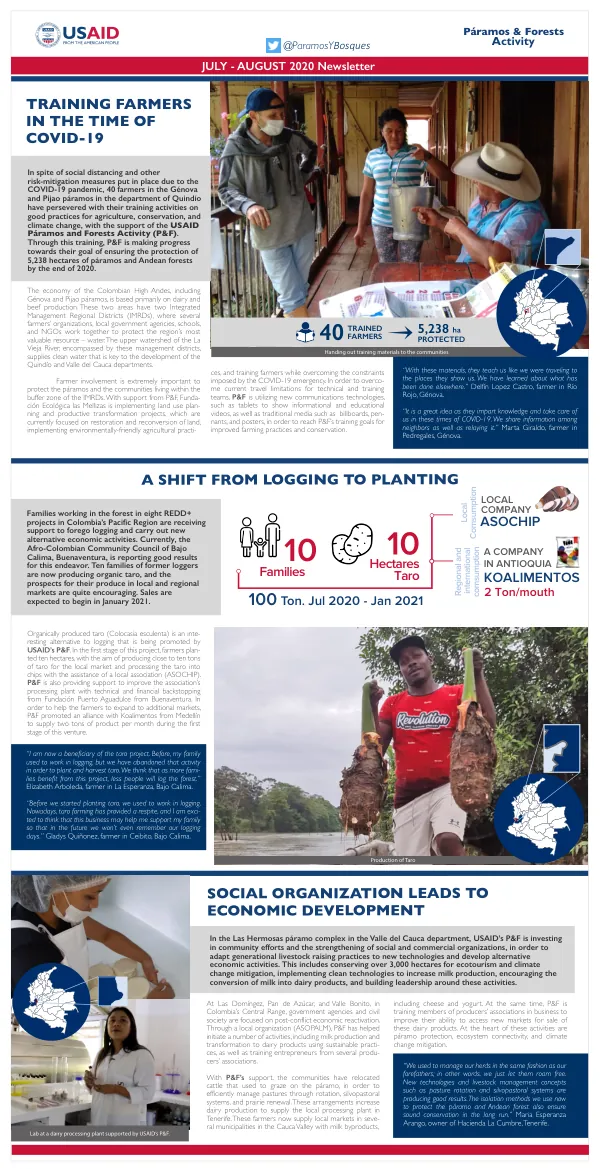
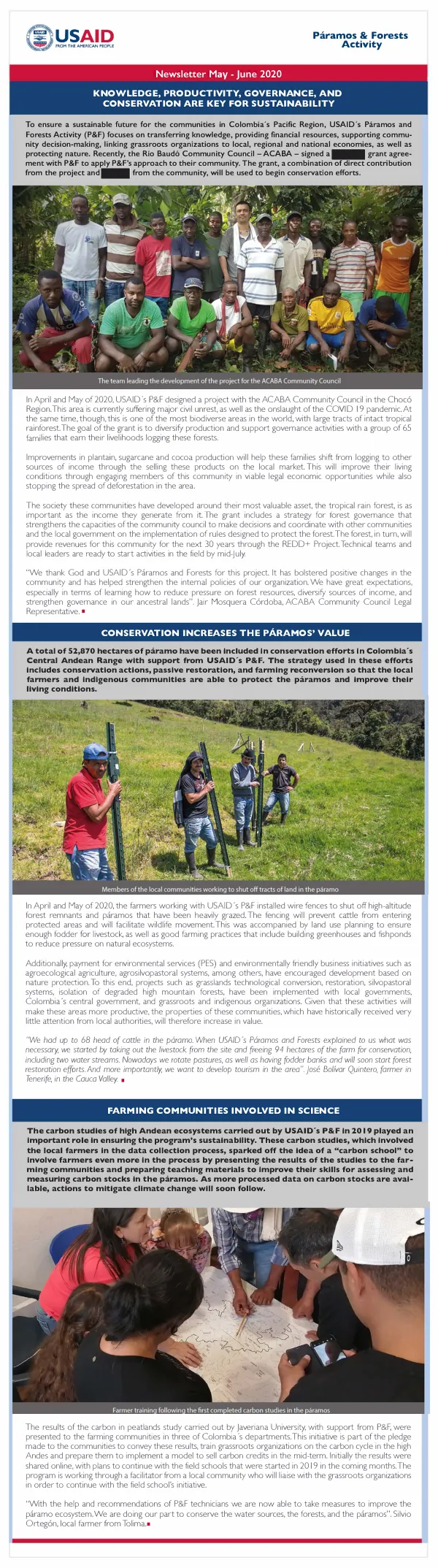
The activity is implemented by USAID and aims to diversify production and support governance activities with a group of 65 families that earn their livelihoods logging tropical rainforests in the Choco Region. The grant agreement signed between USAID's Paramos and Forests Activity and the Rio Baud6 Community Council -ACABA- will be used to begin conservation efforts in the area. The goal of the grant is to improve plantain, sugarcane, and cocoa production, which will help these families shift from logging to other sources of income through the selling of these products on the local market. This will improve their living conditions and stop the spread of deforestation in the area. The society developed around the tropical rainforest is as important as the income generated from it. The grant includes a strategy for forest governance that strengthens the capacities of the community council to make decisions and coordinate with other communities and the local government on the implementation of rules designed to protect the forest. The forest will provide revenues for this community for the next 30 years through the REDD+ Project. A total of 51,870 hectares of paramo have been included in conservation efforts in Colombia's Central Andean Range with support from USAID's Paramos and Forests Activity. The strategy used in these efforts includes conservation actions, passive restoration, and farming reconversion to protect the paramos and improve living conditions for local farmers and Indigenous communities. Farmers working with USAID's P&F have installed wire fences to prevent cattle from entering protected areas and facilitate wildlife movement. Payment for environmental services and environmentally friendly business initiatives have encouraged development based on nature protection. Projects such as grasslands technological conversion, restoration, silvopastoral systems, and isolation of degraded high mountain forests have been implemented with local governments, Colombia's central government, and grassroots and indigenous organizations. These activities will make these areas more productive, increasing the value of the properties of these communities, which have historically received little attention from local authorities.