USAID DEC
Innovation for Agricultural Training and Education: Project-based Learning: Equipping Youth with Agripreneurship by Linking Secondary Agricultural Education to Communities
Sign inOPEN UNIVERSITY
Innovation for Agricultural Training and Education: Project-based Learning: Equipping Youth with Agripreneurship by Linking Secondary Agricultural Education to Communities
Agricultural development initiatives in developing countries face significant challenges, including a declining number of youth engaged in agricultural-related professions.
2016 · 32 pages
Sign in to readA free account is required to download.
Abstract
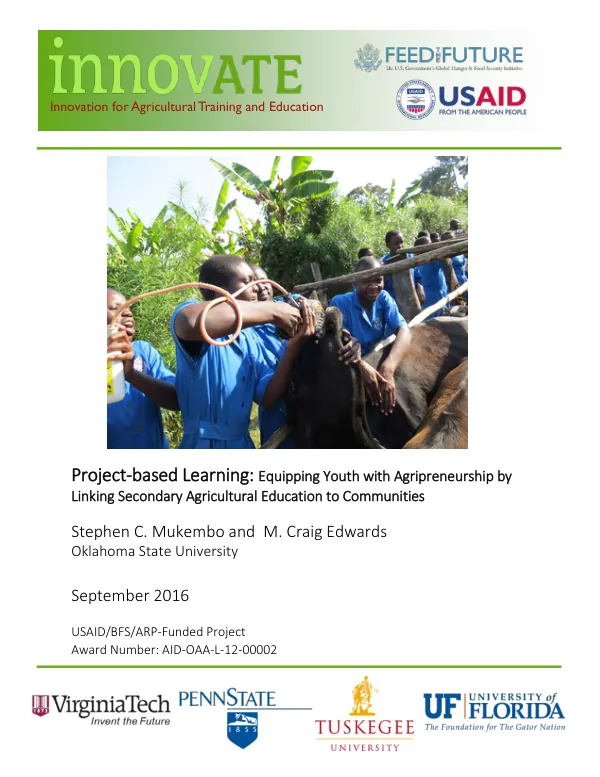
In Africa, where the population is rapidly growing, the situation is particularly distressing. According to the International Labor Organization, youth entrepreneurship in agriculture, or agripreneurship, could be the missing link to address poverty and unemployment among young people. The phenomenon of youth disengagement from agriculture is attributed to the hardships and drudgeries associated with farm work in most developing countries. However, many rewarding and satisfying careers exist in agriculture beyond the farm gate, especially along the agriculture value-chain. To address this issue, project-based learning can be used to equip students with agripreneurship competencies and other valuable life skills while linking secondary agricultural education to communities for improved livelihoods. The approach discussed would help build capacity among secondary school students by facilitating hands-on, minds-on learning experiences to reinforce what they learn in their courses at school. Students would be equipped with skills in agricultural entrepreneurship, foster initiative and creativity in real-world settings through project-based learning, and empowered to educate community members about better methods of farming to increase productivity. This would be a reciprocal and mutualistic relationship where each party benefits from the other. Engaging students with local farmers is one way to bridge the gap between agricultural education in high schools and improving agriculture in the surrounding communities. A multi-disciplinary approach would be adopted that engages teachers of agriculture and entrepreneurship, entrepreneurial farmers, researchers, and extension agents to achieve the project's stated objectives. This would help address some of the current Agricultural Education and Training (AET) challenges in developing countries such as Uganda and elsewhere. Agricultural entrepreneurship has the potential to contribute to a country's economic development by creating employment for the local populace in direct and indirect ways, improving nutrition, and contributing to food security and food sovereignty. The development of mentor-protégé and mutualistic relationships between farmers and students is an important concept to consider. If realized, it would provide feedback to all participants - learners, teachers, community members, and researchers - leading to appropriate recommendations for policymakers, which may help to increase agricultural productivity and food security in the communities and countries involved. The project-based learning approach would involve collaborating research organizations, such as universities and institutes, participating secondary schools with agricultural students and teachers, community outreach-farmers, extension agents, and other stakeholders. This would help address some of the current AET challenges in developing countries and equip students with the skills and knowledge needed to become successful agripreneurs. By linking secondary agricultural education to communities, the project aims to improve livelihoods and increase food security in the communities and countries involved.