TETRA TECH
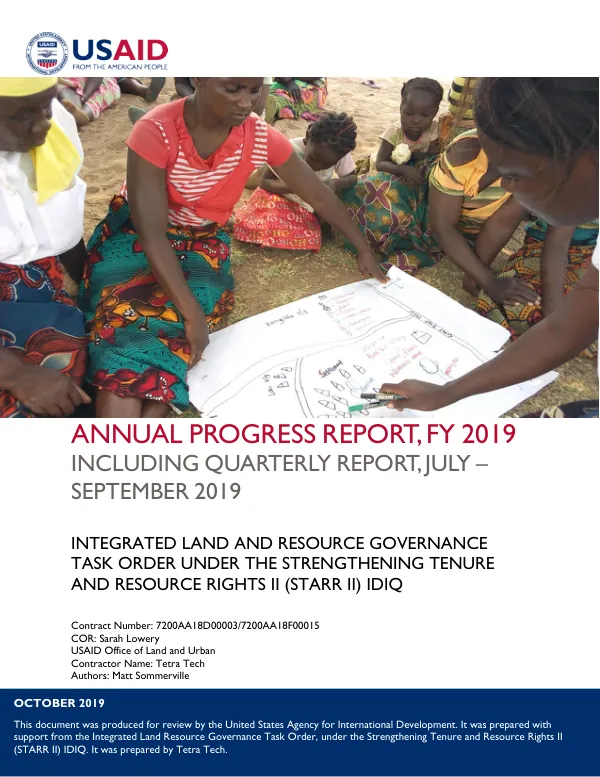
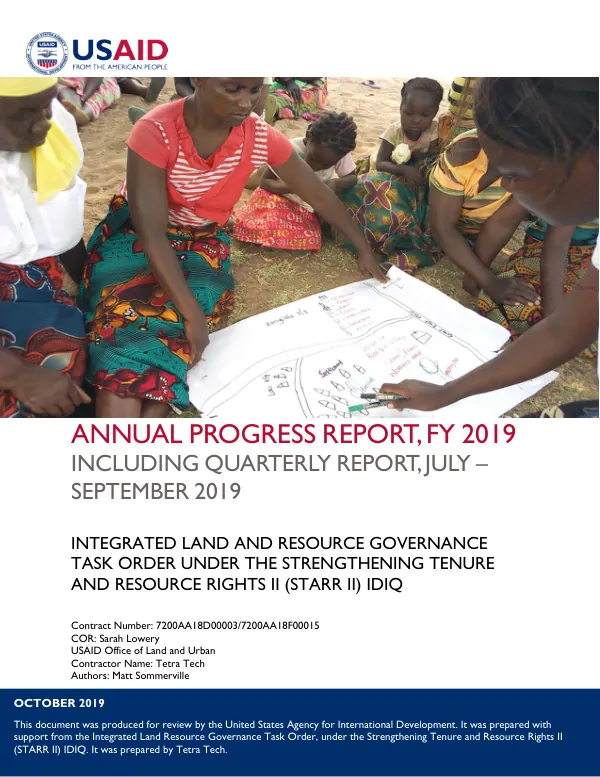
Annual Progress Report, FY 2019: Including Quarterly Report, July – September 2019
The Integrated Land and Resource Governance (ILRG) Task Order under the Strengthening Tenure and Resource Rights II (STARR II) IDIQ was established to support the development of capacity development indicators and tools, as well as environmental mitigation measures and monitoring.
2019 · 58 pages
Sign in to readA free account is required to download.
Abstract
The project's core management activities included the development of capacity development indicators and tools, which aimed to enhance the capacity of local governments and communities to manage land and natural resources effectively. In Mozambique, the project implemented a term activity that focused on outgrower schemes, small-scale irrigation, and land tenure support for surrounding smallholders. The outgrower schemes aimed to improve the livelihoods of smallholder farmers by providing them with access to markets and better prices for their crops. The small-scale irrigation pilot in Zambezia Province aimed to improve crop yields and reduce water scarcity. The project also supported the development of land tenure documentation for smallholder farmers, which helped to secure their rights to the land. In Zambia, the project implemented a term activity that focused on advancing community-based land administration for improved natural resource management and planning. The project worked with local communities to develop and implement land use plans that took into account the needs of both the communities and the natural resources. The project also provided technical assistance to the Zambian government to support the development of policies and laws related to land and natural resource management. The project also supported the development of mobile applications to secure tenure (MAST) in several countries, including Mozambique, Zambia, and India. MAST aimed to provide smallholder farmers with secure tenure to their land, which would enable them to access credit, markets, and other benefits. The project also supported the development of a learning agenda that aimed to identify best practices and lessons learned from the project's activities. The project's activities were implemented in several countries, including Mozambique, Zambia, Mexico, and India. The project worked with local governments, communities, and civil society organizations to support the development of land and natural resource management policies and laws. The project also provided technical assistance to the Zambian government to support the development of policies and laws related to land and natural resource management. The project's performance indicators included the number of communities that developed and implemented land use plans, the number of smallholder farmers that received land tenure documentation, and the number of mobile applications that were developed and implemented. The project's environmental mitigation measures and monitoring plan aimed to minimize the project's impact on the environment and to ensure that the project's activities were sustainable in the long term. The project's success was measured by the number of communities that benefited from the project's activities, the number of smallholder farmers that received land tenure documentation, and the number of mobile applications that were developed and implemented. The project's activities also contributed to the development of policies and laws related to land and natural resource management in several countries. The project's theory of change associated with biodiversity and wildlife conservation areas indicated that the project's activities would contribute to the conservation of biodiversity and wildlife in several countries. The project's activities aimed to support the development of community-based land administration for improved natural resource management and planning, which would help to conserve biodiversity and wildlife. The project's annexes included a list of performance indicators, an environmental mitigation and monitoring report, a success story, a project brief, a list of media, a project staff list, a data list, a level of effort summary, and a theory of change associated with biodiversity and wildlife conservation areas.