USAID DEC
National Chlorine Industries (NCI) Improves Production with Membrane Technology and VFDs
Sign inUSAID
National Chlorine Industries (NCI) Improves Production with Membrane Technology and VFDs
National Chlorine Industries (NCI) in Almowaqqar, Jordan, has implemented operational improvements to reduce its energy consumption and carbon footprint while increasing production.
2015 · 1 pages
Sign in to readA free account is required to download.
Abstract
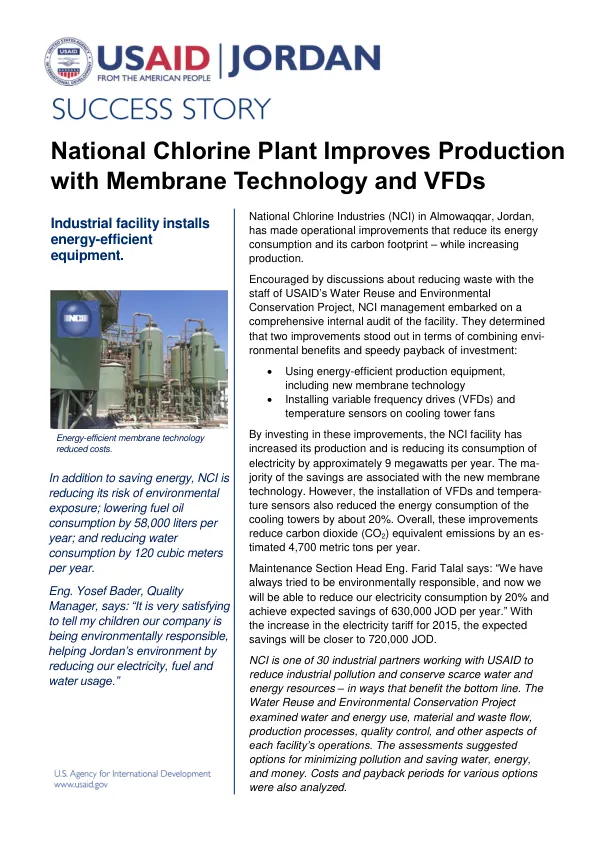
The facility has reduced its electricity consumption by approximately 9 megawatts per year, with the majority of savings attributed to the installation of energy-efficient membrane technology. This technology has also contributed to a reduction in carbon dioxide (CO2) equivalent emissions by an estimated 4,700 metric tons per year. The installation of variable frequency drives (VFDs) and temperature sensors on cooling tower fans has further reduced energy consumption by about 20%. This improvement has resulted in expected savings of 630,000 JOD per year, with the increase in the electricity tariff for 2015 expected to bring the savings closer to 720,000 JOD. The facility's management has emphasized the importance of environmental responsibility, with Quality Manager Eng. Yosef Bader stating that it is satisfying to tell his children that the company is being environmentally responsible and helping Jordan's environment by reducing its electricity, fuel, and water usage. The improvements implemented by NCI are part of a comprehensive internal audit conducted in response to discussions with the staff of USAID's Water Reuse and Environmental Conservation Project. The project examined water and energy use, material and waste flow, production processes, quality control, and other aspects of each facility's operations to identify options for minimizing pollution and saving water, energy, and money. The assessments suggested various options for reducing waste and conserving resources, with costs and payback periods analyzed for each. The installation of energy-efficient production equipment, including new membrane technology, has reduced costs for NCI. Maintenance Section Head Eng. Farid Talal notes that the facility has always tried to be environmentally responsible and is now able to reduce its electricity consumption by 20%. The improvements implemented by NCI are part of a larger effort to reduce industrial pollution and conserve scarce water and energy resources, with the facility working with USAID to achieve these goals. The Water Reuse and Environmental Conservation Project has worked with 30 industrial partners, including NCI, to identify opportunities for reducing pollution and conserving resources. The project has examined various aspects of each facility's operations to identify options for minimizing waste and conserving resources, with costs and payback periods analyzed for each. The improvements implemented by NCI are expected to have a significant impact on the facility's operations and the environment, with the facility reducing its carbon footprint and increasing its production while saving money.