INTERNATIONAL ORGANIZATION FOR MIGRATION
Justice & Amnesty in the Peace Accord
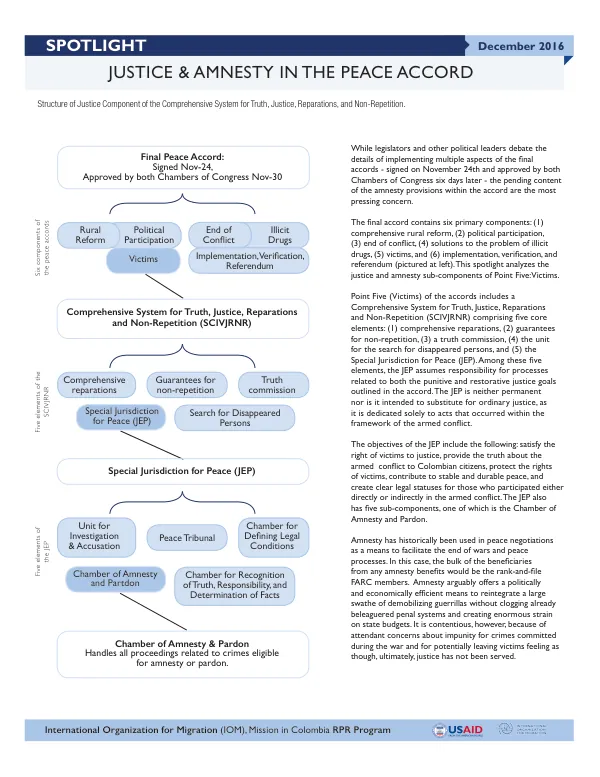
The Comprehensive System for Truth, Justice, Reparations, and Non-Repetition (SCIVJRNR) is a key component of the peace accords signed on November 24, 2016, and approved by both Chambers of Congress on November 30, 2016.
2016 · 2 pages
Sign in to readA free account is required to download.
Abstract
The SCIVJRNR comprises five core elements: comprehensive reparations, guarantees for non-repetition, a truth commission, the unit for the search for disappeared persons, and the Special Jurisdiction for Peace (JEP). The JEP is responsible for processes related to both punitive and restorative justice goals outlined in the accord. The JEP has five sub-components, one of which is the Chamber of Amnesty and Pardon. The Chamber of Amnesty and Pardon handles all proceedings related to crimes eligible for amnesty. The design of the criteria for amnesty is such that the "broadest possible" terms will be permitted within the framework of the final accords, International Human Rights Law, International Humanitarian Law, and the Rome Statute. The principle of favorability will be applied in the event that amnesty has not already been explicitly prohibited for a particular crime within these frameworks. The criteria for determining eligibility for amnesty include political and related crimes defined by inclusive and exclusive criteria. Inclusive criteria include crimes related to the development of the rebellion committed within the armed conflict, crimes in which the passive subject of the conduct is the state and its current constitutional regiment, and acts intended to facilitate, support, finance, or hide the development of the rebellion. Exclusive criteria exclude international crimes and those covered by international law and the Rome Statute. Crimes that may be considered for amnesty include rebellion, sedition, coup, illegal possession of arms, combat deaths that conform to International Humanitarian Law standards, conspiracy to commit rebellion, and related crimes. The decision tree for determining individuals' eligibility for amnesty and pardon within the Chamber of Amnesty, Pardon, and Special Penal treatments is as follows: if the non-state actor is armed and a verified member of the FARC and a signator on the accord, and has been charged with a political or related offense that qualifies for amnesty, the individual will be processed within the Chamber of Amnesty & Pardon. If the person has been charged with an offense not related to the armed conflict, they will not be processed within the Chamber of Amnesty & Pardon. If the alleged offense qualifies for amnesty or pardon, the individual will pass through processes distinct from but equitable to non-state actors.