USAID DEC
Sistema Integral de Paz ENG
The Comprehensive System of Truth, Justice, Reparation, and Non-Repetition is a framework for addressing the impacts of the armed conflict in Colombia.
1 pages
Sign in to readA free account is required to download.
Abstract
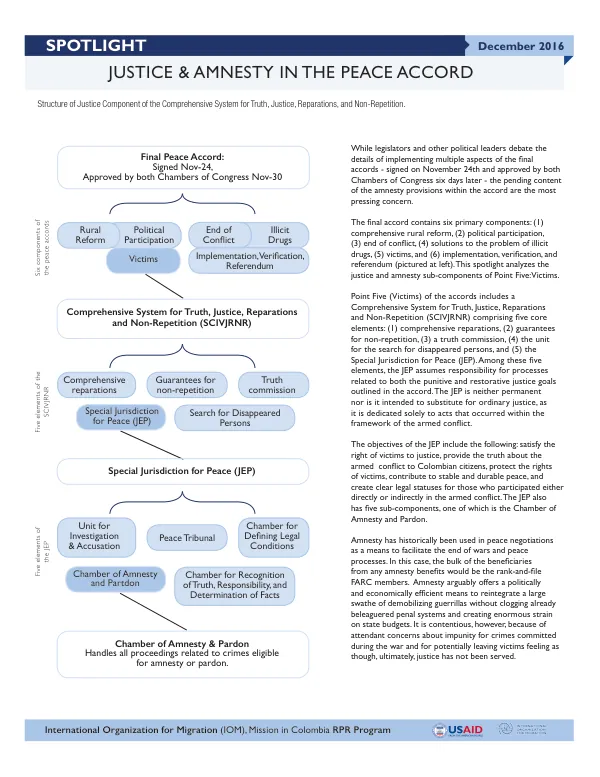
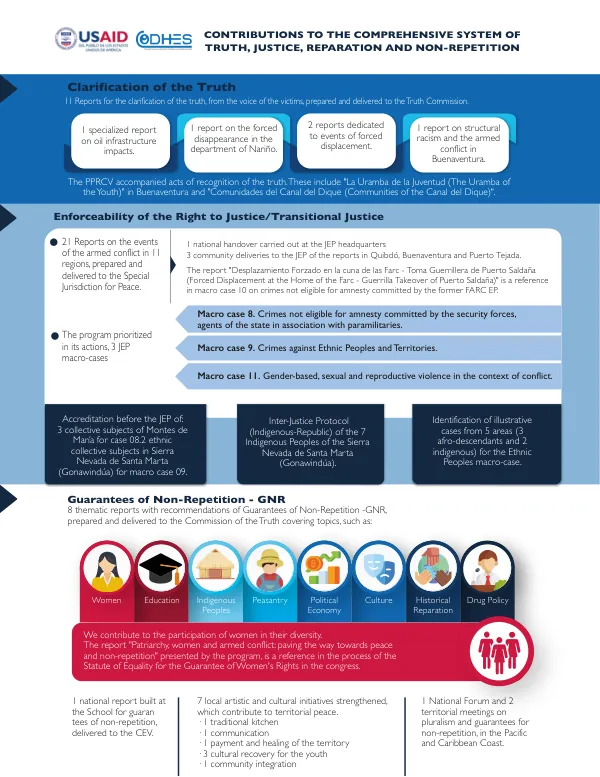
The system is comprised of several key components, including the Special Jurisdiction for Peace (JEP), the Truth Commission, and the Commission of the Truth. The JEP is responsible for investigating and prosecuting crimes committed during the conflict, including those committed by state agents and paramilitaries. The JEP has identified several macro cases, including Macro Case 8, which focuses on crimes committed by security forces and paramilitaries, and Macro Case 9, which addresses crimes against ethnic peoples and territories. The Truth Commission has prepared and delivered 21 reports on the events of the armed conflict in 11 regions, providing a comprehensive understanding of the conflict's impacts. The Commission has also identified illustrative cases from 5 areas, including 3 afro-descendant and 2 indigenous communities, for the Ethnic Peoples macro-case. The program has also contributed to the participation of women in their diversity, with a report titled "Patriarchy, women and armed conflict: paving the way towards peace and non-repetition" serving as a reference in the process of the Statute of Equality for the Guarantee of Women's Rights in the congress. The report highlights the importance of addressing the root causes of the conflict, including patriarchy and gender-based violence. Guarantees of Non-Repetition (GNR) are a critical component of the Comprehensive System, and the program has prepared and delivered 11 reports to the Truth Commission, providing a voice for victims and clarifying the truth about the conflict. The program has also carried out national and community deliveries of reports, including a national handover at the JEP headquarters and community deliveries in Quibdó, Buenaventura, and Puerto Tejada. The program has also prioritized the strengthening of local artistic and cultural initiatives, which contribute to territorial peace. Seven local initiatives have been strengthened, including traditional kitchens, communication initiatives, and cultural recovery programs for youth. Additionally, the program has organized a National Forum and 2 territorial meetings on pluralism and guarantees for non-repetition, bringing together stakeholders from the Pacific and Caribbean Coast. The program has also focused on Macro Cases 8, 9, and 11, which address crimes not eligible for amnesty, crimes against ethnic peoples and territories, and gender-based, sexual, and reproductive violence in the context of conflict, respectively. The program has worked closely with indigenous peoples, including the 7 Indigenous Peoples of the Sierra Nevada de Santa Marta (Gonawindúa), to ensure that their voices and perspectives are represented in the Comprehensive System. Overall, the Comprehensive System of Truth, Justice, Reparation, and Non-Repetition is a critical framework for addressing the impacts of the armed conflict in Colombia. The program's work has provided a comprehensive understanding of the conflict's impacts and has contributed to the development of guarantees of non-repetition, which are essential for preventing future conflicts and promoting peace and reconciliation in Colombia.