USAID
Justicia Restaurativa
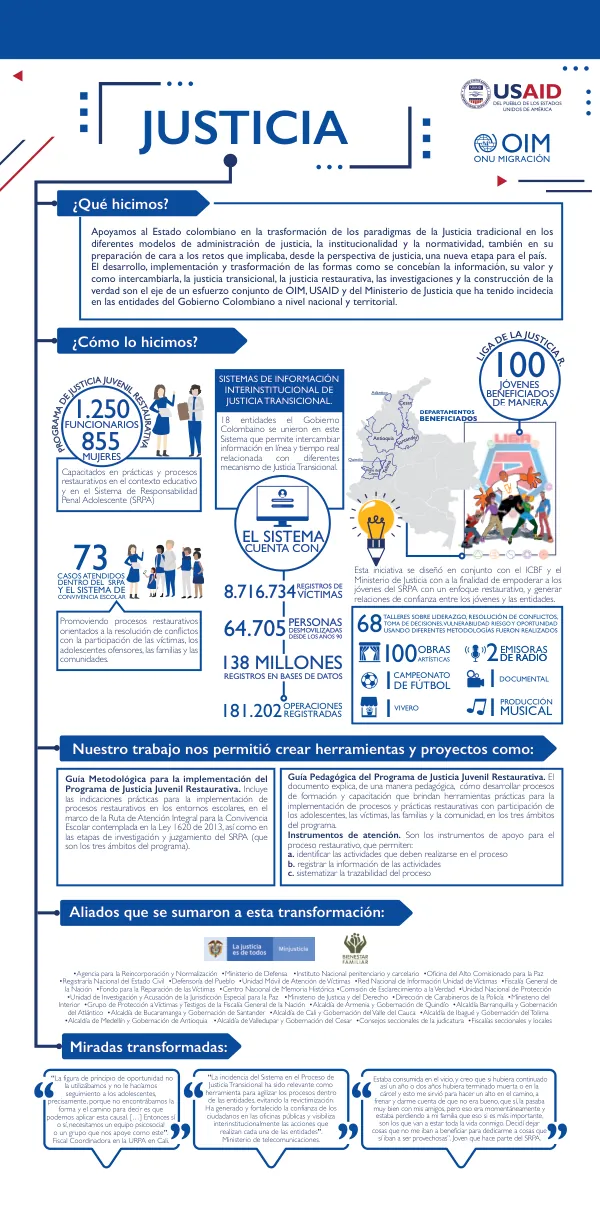
The Colombian government's transformation of traditional justice paradigms into modern models of administration, institutionalization, and normativity was a key focus of a joint effort between the International Organization for Migration (OIM), the United States Agency for International Development (USAID), and the Colombian Ministry of Justice.
2020 · 1 pages
Sign in to readA free account is required to download.
Abstract
This initiative aimed to prepare the country for the challenges of a new era, with a focus on transitional justice, restorative justice, investigations, and truth construction. The project involved the development and implementation of tools and projects, such as the Sistema de Información Interinstitucional de Justicia Transicional (SIIT), a system that enables the exchange of information in real-time across different entities involved in transitional justice. This system has been instrumental in streamlining processes, preventing revictimization, and generating trust among citizens in public institutions. The initiative also focused on empowering young people through a restorative approach, with the goal of creating relationships of trust between young people and institutions. This was achieved through the implementation of the Programa de Justicia Juvenil Restaurativa (PJJR), which included the development of a Guía Metodológica and a Guía Pedagógica. These guides provided practical instructions for the implementation of restorative processes in schools, as well as in the investigation and judgment stages of the Sistema de Responsabilidad Penal Adolescente (SRPA). The project also involved the training of officials, including women, in restorative practices in the context of education and the SRPA. This training aimed to promote restorative processes that involve the participation of victims, offenders, families, and communities. As a result, 64,705 people were desmovilized since the 1990s, and 181,202 operations were registered in the SIIT system. The initiative also included the production of artistic works, such as 100 artistic pieces, 2 radio documentaries, 1 musical production, and 1 documentary, as well as the organization of 1 football championship. These activities aimed to promote leadership, conflict resolution, decision-making, vulnerability, risk, and opportunity among young people. The project's impact was significant, with 1,250 young people benefiting directly from the initiative, and 855 of them being trained in restorative practices. Additionally, 73 women were trained in restorative practices, and 64,705 people were desmovilized since the 1990s. The SIIT system registered 181,202 operations, and 8,716,734 records of victims were registered.
Related documents