USAID DEC
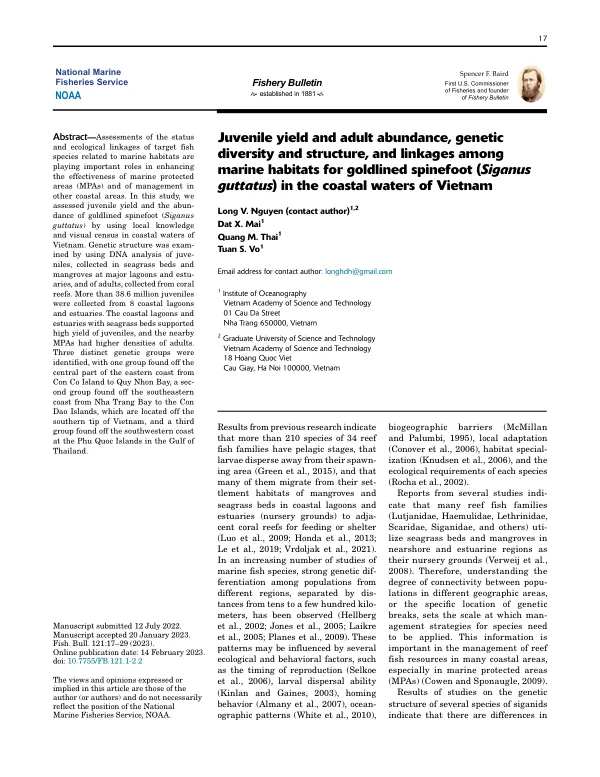
Juvenile yield and adult abundance, genetic diversity and structure, and linkages among marine habitats for goldlined spinefoot (Siganus guttatus) in the coastal waters of Vietnam
Sign inNATIONAL UNIVERSITY OF SCIENCES AND TECHNOLOGY , ISLAMABAD
Juvenile yield and adult abundance, genetic diversity and structure, and linkages among marine habitats for goldlined spinefoot (Siganus guttatus) in the coastal waters of Vietnam
The goldlined spinefoot (Siganus guttatus) is a species of fish widely distributed in shallow-water habitats in the Indo-Pacific region.
2023 · 13 pages
Sign in to readA free account is required to download.
Abstract
It is one of the most economically important commercial fishes in tropical and subtropical regions, attracting attention from the aquaculture industry. The species has a complex life cycle with linkages to different habitats at different stages, including seagrass beds, mangrove swamps, coral reefs, and sandy and rocky bottoms. In the coastal waters of Vietnam, juvenile goldlined spinefoot have been recruited to seagrass beds and mangrove swamps in the central part of the country from Thua Thien Hue Province to Binh Dinh Province. Large numbers have been observed settling during the dark phase of the moon in the summer months from May to August, and sometimes in September. Adults have been found in the major coral reefs along the coast and around nearshore islands. Large schools of juvenile goldlined spinefoot have been caught by purse seine, lift net, stow net, and long trap cage along the coast of Vietnam, including in Thi Nai Lagoon and in Thu Bon estuary. The aims of this study were to assess the juvenile yield and adult abundance of goldlined spinefoot, to determine the genetic diversity, structure, and linkages of juvenile goldlined spinefoot collected in coastal estuaries and lagoons and of broodstock collected in coral reefs in coastal waters of Vietnam, and to provide a baseline for future management decisions regarding this species in Vietnam. Assessments of juvenile yield were conducted through consultations with local communities, while genetic analysis was performed on DNA samples collected from juvenile and adult goldlined spinefoot. The study found that the coastal lagoons and estuaries with seagrass beds supported high yield of juveniles, and the nearby marine protected areas had higher densities of adults. Three distinct genetic groups were identified, with one group found off the central part of the eastern coast from Con Co Island to Quy Nhon Bay, a second group found off the southeastern coast from Nha Trang Bay to the Con Dao Islands, and a third group found off the southwestern coast at the Phu Quoc Islands in the Gulf of Thailand. The study also found that the goldlined spinefoot has a complex life cycle with linkages to different habitats at different stages, and that understanding the genetic structure of populations of this species is important for developing effective strategies for its proper and sustainable management. The results of this study provide a baseline for future management decisions regarding the goldlined spinefoot in Vietnam. The study highlights the importance of understanding the genetic structure of populations of this species and the need for effective management strategies to ensure the sustainable use of this resource. The study also emphasizes the need for further research on the distribution of juveniles and broodstocks at a larger spatial scale to inform management decisions.
Related documents