USAID DEC
Restoration of the Silver-Lipped Pearl Oyster Pinctada maxima (Jameson, 1901) in Phu Quoc Marine Protected Area, Vietnam
Sign inUSAID DEC
Restoration of the Silver-Lipped Pearl Oyster Pinctada maxima (Jameson, 1901) in Phu Quoc Marine Protected Area, Vietnam
The silver-lipped pearl oyster restoration project was conducted at Hon Vang islet in Phu Quoc Marine Protected Area, Vietnam.
2021 · 10 pages
Sign in to readA free account is required to download.
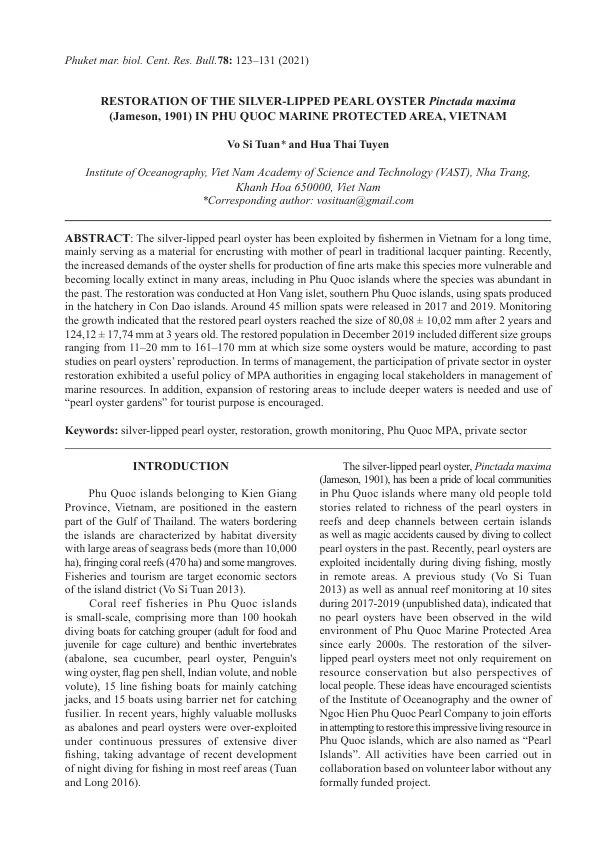
Abstract
The project aimed to restore the population of Pinctada maxima, a species that has been over-exploited for its shells in traditional lacquer painting and fine arts. The restoration site was characterized by a hard rock substratum, which is critical for the habitat of silver-lipped pearl oysters. The restoration practice involved releasing approximately 45 million spats produced in the hatchery at Con Dao islands. The spats were released twice a year in 2017 and 2019, and monitoring of the growth indicated that the restored pearl oysters reached the size of 80.08 ± 10.02 mm after 2 years and 124.12 ± 17.74 mm at 3 years old. The restored population in December 2019 included different size groups ranging from 11-20 mm to 161-170 mm, at which size some oysters would be mature. The study site was located in the western part of coral reefs bordering Hon Vang islet, with a hard coral abundance of 33% at 6 m and 15% at 8 m. Soft corals were more common in the deeper water, and sponges were observed as a common biological feature. The rock and sand substrata dominated the non-biological features, with no silt found at the site. The restoration practice and initial outputs showed that the first release of pearl oyster spats was conducted on February 24, 2017, and the second release on November 16, 2017. The number of released spats increased over the experimental period, from 1.1 million to 26.143 million for the 1st and 4th time, respectively. The data series collected in June 2017 indicated that the first released spats were growing well, reaching the average size of 18.27 ± 0.64 mm after 4 months. The restored pearl oysters showed a significant growth rate, with an average size increase of 4.56 mm per month. The restored population in December 2019 included different size groups, indicating a successful restoration of the silver-lipped pearl oyster population. The study highlights the importance of habitat diversity and the critical role of hard rock substratum in the habitat of silver-lipped pearl oysters. The participation of the private sector in oyster restoration exhibited a useful policy of MPA authorities in engaging local stakeholders in management of marine resources. The expansion of restoring areas to include deeper waters is needed, and the use of "pearl oyster gardens" for tourist purposes is encouraged. The study provides valuable insights into the restoration of the silver-lipped pearl oyster population and highlights the importance of conservation efforts in protecting this species.