USAID DEC
Kewenangan LIPI dalam Implementasi CITES
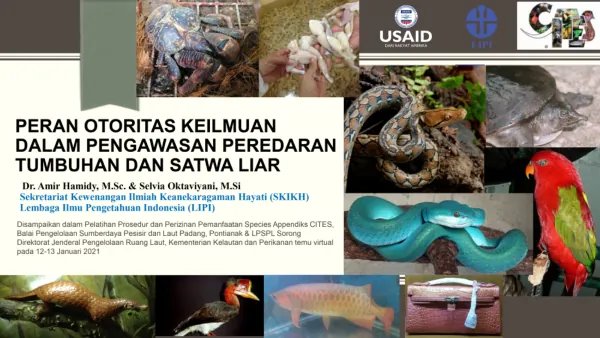
KEWENANGAN LIPI LIPI is an institution that holds authority in various aspects, including the provision of scientific data and weighing in on conservation of biodiversity, including implementation of international conventions such as the Convention on International Trade in Endangered Species of Wild Fauna and Flora (CITES) and the Convention on Biological Diversity (CBD).
2021 · 22 pages
Sign in to readA free account is required to download.
Abstract
According to Government Regulation (PP) No. 7/1999 on the Conservation of Plant and Animal Species, PP No. 8/1999 on the Utilization of Wild Plant and Animal Species, and PP No. 60/2007 on the Conservation of Fish Resources, LIPI is designated as a scientific authority with the following powers: 1. Providing recommendations to the management authority on the classification, quota, and trade of plant and animal species, including export, re-export, import, and introduction of all specimens from the sea. 2. Monitoring trade permits and realizations, and providing recommendations to the management authority on restrictions on the issuance of trade permits for wild plant and animal species based on biological evaluations that such restrictions are necessary. 3. Acting as an independent party providing recommendations on international conventions in the field of conservation of wild plant and animal species. 4. Providing recommendations on the utilization of wild plant and animal species for research purposes that will be taken abroad. CITES is a type of agreement among member countries to control international trade in endangered species of wild flora and fauna. The goal is to prevent the extinction of species that may be caused by international trade. CITES is implemented through the principles of legality, traceability, and sustainability. Control is carried out by issuing permits by the management authority (MA) after consideration by the scientific authority (SA). CITES was first established in the 1960s due to concerns from several countries about the increasing volume of international trade in wild plant and animal species. The species traded varied from live specimens to various products derived from them. CITES began to operate effectively on July 1, 1975. Indonesia became the 48th member on December 28, 1978, and the entry into force was on March 28, 1979. The implementation of CITES is based on three appendices. Appendix I includes species that are considered to be on the brink of extinction and require strict international treatment. Appendix II includes species that are considered rare and require international treatment. Appendix III includes species that are considered rare and are monitored internationally by the country of origin. The implementation of CITES in Indonesia is based on several laws and regulations, including Law No. 5/1990 on the Conservation of Living Natural Resources and Ecosystems, Law No. 31/2004 on Fisheries, Government Regulation No. 7/1999 on the Conservation of Plant and Animal Species, Government Regulation No. 8/1999 on the Utilization of Wild Plant and Animal Species, Government Regulation No. 60/2007 on the Conservation of Fish Resources, Minister of Environment Regulation No. 447/2003 on the Organization of the Taking or Capture and Trade of Wild Plant and Animal Species, Minister of Environment Regulation No. 19/2005 on the Breeding of Wild Plant and Animal Species, and Minister of Maritime Affairs and Fisheries Regulation No. 61/2018 on the Procedure for Utilizing Fish Species. The tasks of the scientific authority under CITES include determining whether the export of a species listed in Appendices I and II, and the import of a species listed in Appendix I, will not harm or cause extinction. The scientific authority also monitors export permits issued and the actual export of species to ensure that a species is maintained at a level consistent with its role in the wild and to prevent the introduction of the species into Appendix I. The scientific authority provides recommendations on the registration of breeding facilities and the disposal of confiscated goods. The scientific authority also assists in preparing proposals for changes to the appendices regarding the biological status of species affected by trade.
Related documents