USAID DEC
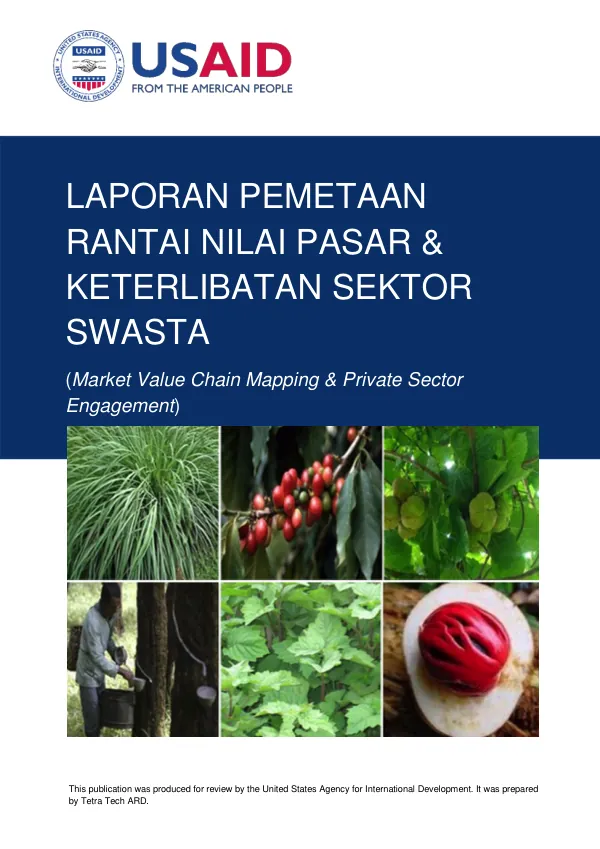
Laporan Pemetaan Rantai Nilai Pasar & Keterlibatan Sektor Swasta (Market Value Chain Mapping & Private Sector Engagement)
Sign inTETRA TECH ARD, INC.
Laporan Pemetaan Rantai Nilai Pasar & Keterlibatan Sektor Swasta (Market Value Chain Mapping & Private Sector Engagement)
Private sector engagement plays an important role in supporting low emissions development as well as conservation and sustainable development.
2016 · 82 pages
Sign in to readA free account is required to download.
Abstract
In the Leuser Landscape, each district has potential commodities to be developed that can enhance community wellbeing. Although these communities have put forth much effort to maximize their production, some barriers remain. These include supply input, regulation, institutional support, and market access. The identification of key private sector players in the project landscape was performed in order to build partnerships for investment in conservation. This was done through data collection, both primary and secondary, as well as through discussion with market players and direct interview. The assessment found potential commodities in the area that are worth targeting for future intervention, both on-farm and off-farm, and linking with potential markets. The potential commodities identified in the Leuser Landscape include organic cacao, patchouli, lemongrass, pine resin, and candlenut in Gayo Lues; organic cacao, candlenut, and palm sugar in Southeast Aceh; and nutmeg, patchouli, and cacao in South Aceh. The assessment findings demonstrate a need to develop a business model in order to collaborate with potential private sector companies/markets as part of market access intervention. Furthermore, other interventions are also crucial such as access to technology, access to supply input, financial access, and farmer group empowerment. Implementation of the project will focus on developing and demonstrating a sustainable business model that can be replicated and scaled up. This will involve working with private sector companies to develop and implement sustainable practices, as well as providing training and capacity building for farmers and other stakeholders. The project will also focus on building partnerships with local governments and other stakeholders to support the development of sustainable agriculture practices and to promote the adoption of sustainable agriculture practices among farmers. The project will be implemented in six strategic landscapes in three major islands of Indonesia, including Sumatra, Java, and Kalimantan. The project will focus on developing and demonstrating sustainable agriculture practices that can be replicated and scaled up, and will work with private sector companies to develop and implement sustainable practices. The project will also focus on building partnerships with local governments and other stakeholders to support the development of sustainable agriculture practices and to promote the adoption of sustainable agriculture practices among farmers. The project will have a significant impact on the environment, as it will help to reduce greenhouse gas emissions and promote the conservation of biodiversity. The project will also have a positive impact on the livelihoods of farmers and other stakeholders, as it will provide them with access to new markets and opportunities for economic growth. The project will also contribute to the development of sustainable agriculture practices and the promotion of sustainable agriculture practices among farmers.
Related documents