USAID DEC
Pengenalan, Identifikasi dan Metode survei Kelelawar (Chiroptera)
The order Chiroptera, commonly referred to as bats, comprises a diverse group of mammals with a wide range of characteristics.
2021 · 34 pages
Sign in to readA free account is required to download.
Abstract
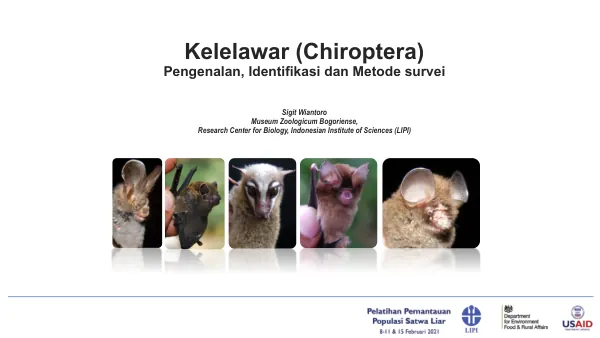
The name Chiroptera originates from the Greek words cheir, meaning hand, and pteron, meaning wing. This order is divided into 21 families, 233 genera, and 1439 species, with 9 species considered extinct. Bats account for approximately 20% of the total number of mammalian species. The diversity of bats is evident in their distribution across the globe, with 10 families, 55 genera, and 239 species found in Indonesia. This represents 17% of the world's bat species. The Indonesian bat fauna is comprised of 81 fruit-eating species and 158 insectivorous species. Three species, Pteropus pumilus, Neopteryx frosti, and Acerodon humilis, are protected under conservation laws, while 25 species are listed as appendix 2 under the Convention on International Trade in Endangered Species of Wild Fauna and Flora (CITES). Some bat species, particularly the flying foxes (Pteropus spp.), are included in quota proposals for utilization. Bats exhibit a range of roosting behaviors, including roosting in caves, trees, and buildings. They often hang from branches or tree trunks, or roost in hollows or leaf clusters. In addition to these natural habitats, bats have also been found roosting in human-made structures such as houses and bridges. Foraging habitats for bats include forest interiors, edges, and gaps, as well as open spaces. They often forage in groups, and their activities play a crucial role in maintaining ecosystem balance. Bats contribute to their ecosystems in various ways, including as pollinators, seed dispersers, and bioindicators. They also serve as a food source for other animals and are a potential reservoir for diseases such as SARS-CoV-2, Nipah virus, and Hendra virus. However, bats face several threats, including habitat destruction and degradation, hunting, and trade. The main threats to bat habitats are land-use changes, mining, and other human activities that alter their roosting and foraging sites.