BANK FOR WEST AFRICAN DEVELOPMENT
Key concepts for climate change adaptation
Climate change adaptation involves understanding and addressing the impacts of climate variability and change on natural and human systems.
2011 · 3 pages
Sign in to readA free account is required to download.
Abstract
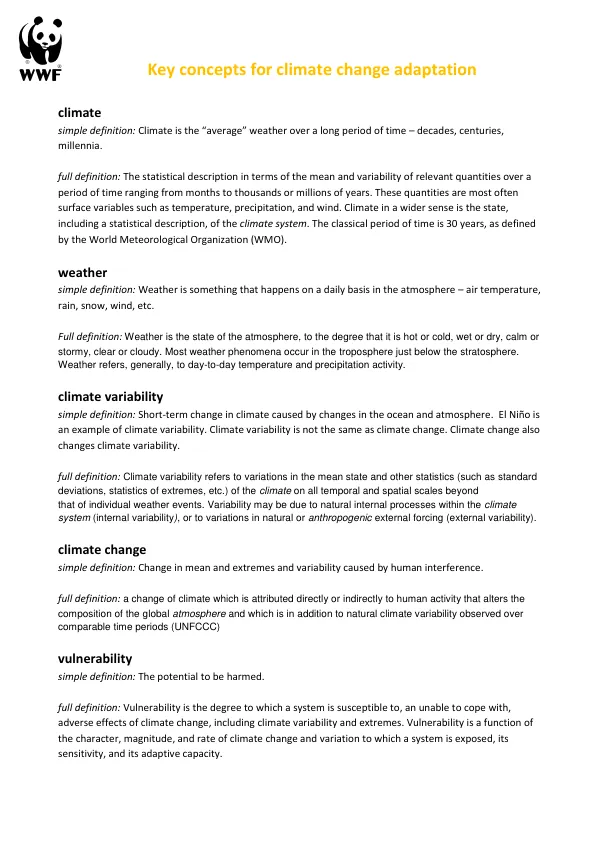
Climate is defined as the average weather over a long period of time, typically decades, centuries, or millennia. It is characterized by the statistical description of relevant quantities such as temperature, precipitation, and wind over a specific period. Climate variability refers to short-term changes in climate caused by changes in the ocean and atmosphere. Examples of climate variability include El Niño events. Climate change, on the other hand, is a change in the mean and extremes of climate caused by human interference. It is attributed to human activities that alter the composition of the global atmosphere and is in addition to natural climate variability observed over comparable time periods. Vulnerability is the degree to which a system is susceptible to and unable to cope with adverse effects of climate change, including climate variability and extremes. It is a function of the character, magnitude, and rate of climate change and variation to which a system is exposed, its sensitivity, and its adaptive capacity. Impacts are the manifestation of vulnerability, including the damage caused by climate and weather-related hazards. Adaptation involves actions taken to reduce vulnerability to actual or expected changes in climate. It includes anticipatory and reactive adaptation, private and public adaptation, and autonomous and planned adaptation. Mitigation, on the other hand, involves actions to reduce the sources or increase the sinks of greenhouse gases. Mainstreaming is the incorporation of climate change adaptation initiatives into other existing policies, programs, and resource management structures. Reducing Emissions from Deforestation and Forest Degradation (REDD) is a strategy that uses market and financial incentives to reduce greenhouse gas emissions from deforestation and forest degradation. Disaster Risk Reduction (DRR) aims to reduce socio-economic vulnerabilities to disasters, including those triggered by climate change. Maladaptation is an adaptation action that leads to increased vulnerability to climate change, often resulting from short-sighted planning or non-inclusive planning. Community-based adaptation (CbA) is a community-led process based on communities' priorities, needs, knowledge, and capacities. Ecosystem-based adaptation (EbA) involves the use of biodiversity and ecosystem services as part of an overall adaptation strategy to help people adapt to the adverse effects of climate change. Coping refers to actions taken in response to an extreme event, such as a storm or drought, to ensure survival, often resulting in a long-term decrease in wellbeing. Resilience building helps ensure that ecosystems and communities can return to a normal state of wellbeing following an extreme event or other climate-related disturbance. Development in a changing climate aims to enhance human wellbeing for the world's poor, while also building resilience to extreme events and other disturbances. Conservation in a changing climate requires flexibility and the ability to facilitate change in ecosystems that minimize loss of biodiversity.
Related documents