PALLADIUM INTERNATIONAL, LLC
Key Population Identifier Code (KPIC) Monitoring Plan
The Key Population Identifier Code (KPIC) Monitoring Plan is a document developed by Data.FI, a global HIV/AIDS project funded by the U.S.
2021 · 24 pages
Sign in to readA free account is required to download.
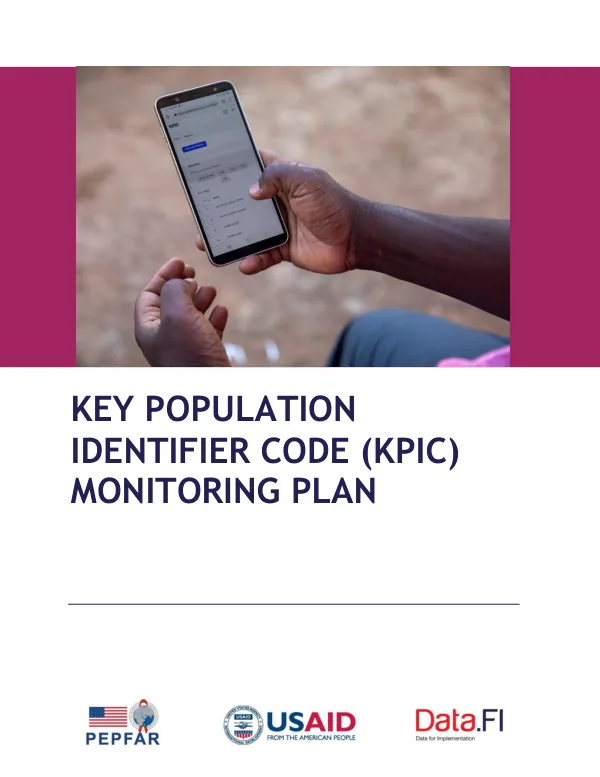
Abstract
President's Emergency Plan for AIDS Relief (PEPFAR). The plan aims to address challenges in providing consistent care to key populations (KPs) in Uganda, who experience disproportionately high rates of HIV and poor clinical outcomes. The KPIC solution was developed to create a unique and anonymous identification system for KPs in Uganda. This system facilitates KPs' safe access to HIV prevention and treatment services in three ways. First, the KPIC creates anonymity for KPs, reducing the risk of personally identifiable information and HIV status being leaked. Second, the KPIC links client records across service locations, healthcare facility types, districts, and implementing partners, supporting tracking and follow-up with KPs who are transient or may access HIV services at multiple facilities. Finally, the KPIC allows HIV data managers to identify and reduce duplicate KP member records, increasing the completeness of patients' healthcare files and reducing the risk of double counting cases. The KPIC was designed to adhere to privacy and security standards, protecting KPs' identity and shielding them from the danger of legal problems and jail time. The system meets four requirements crucial for its success: usability at multiple facilities, handling alternative or false names, providing a unique identifier code, and ensuring data security and integrity. The KPIC innovation aims to support improved client outcomes in linkage, retention, and viral suppression, improve continuity of client care, protect clients' rights, and contribute to HIV epidemic control. The system has been designed to be widely and securely used without the need for device management and an expensive security infrastructure. The KPIC Monitoring Plan outlines the purpose and scope of the KPIC solution, including its key features and benefits. The plan also discusses the challenges faced by KPs in Uganda, including insufficient linkage to healthcare services, duplicate entries in the KP Tracker, and difficulty managing KP case files. The KPIC solution addresses these challenges by creating a unique and anonymous identification system for KPs, linking client records across service locations, and reducing duplicate records. The KPIC system has been designed to be user-friendly and accessible to multiple facilities, handling alternative or false names, and providing a unique identifier code. The system also ensures data security and integrity, protecting KPs' identity and shielding them from the danger of legal problems and jail time. The KPIC Monitoring Plan is a critical component of the KPIC solution, providing a framework for monitoring and evaluating the effectiveness of the system. The plan outlines the key performance indicators (KPIs) and data collection methods, as well as the reporting and learning mechanisms. The plan also discusses the importance of adaptive management and learning, ensuring that the KPIC system is continuously improved and refined to meet the evolving needs of KPs in Uganda. Overall, the KPIC Monitoring Plan is a comprehensive document that outlines the purpose, scope, and key features of the KPIC solution. The plan provides a framework for monitoring and evaluating the effectiveness of the system, ensuring that it is continuously improved and refined to meet the evolving needs of KPs in Uganda.