USAID DEC
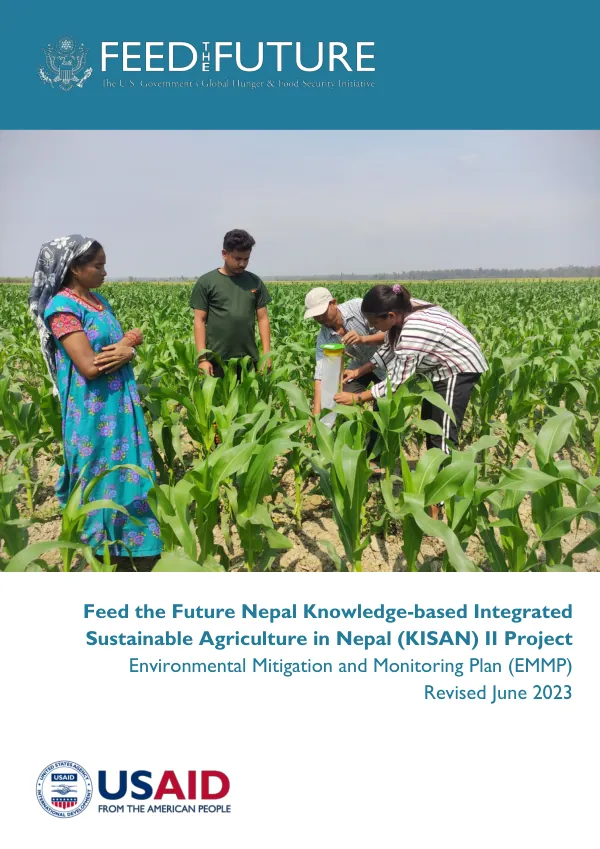
Knowledge-Based Integrated Sustainable Agriculture and Nutrition (KISAN) Project - Environmental Mitigation and Monitoring Plan (EMMP)
Sign inUSAID
Knowledge-Based Integrated Sustainable Agriculture and Nutrition (KISAN) Project - Environmental Mitigation and Monitoring Plan (EMMP)
The Knowledge-Based Integrated Sustainable Agriculture and Nutrition (KISAN) Project is a multifaceted initiative implemented in Nepal as part of the Feed the Future Initiative.
2013 · 13 pages
Sign in to readA free account is required to download.
Abstract
The project aims to sustainably reduce poverty and hunger in Nepal by achieving inclusive growth in the agriculture sector, increasing the incomes of farm families, and improving nutritional status, especially of women and children. The project is implemented in collaboration with Nepali organizations as subcontractors and focuses on ten districts in the Bheri and Rapti Zones of the Mid-Western Development Region. KISAN integrates agriculture and nutrition to increase agricultural production and improve the nutritional status of women and children under the age of five. The project has three primary and integrated components: Agricultural Productivity, Improved Nutrition, and Skills Development. KISAN focuses on Components 1 and 2 and aims to achieve seven major outputs. These outputs include farmers receiving improved and increased agricultural inputs, improved capacity of agriculture extension workers, service providers, and farmers, improved and sustainable agriculture production and post-harvest technologies and practices adopted at the farm level, improved market efficiency, increased capacity of the Government of Nepal and Nepali organizations for agriculture-related technology identification and dissemination, improved knowledge and behavior on agricultural, nutrition, hygiene, and sanitation practices, and improved access to water and sanitation facilities. The project's Environmental Mitigation and Monitoring Plan (EMMP) identifies potential environmental impacts associated with the project activities. These impacts include habitat conversion, threats to critical habitats for endangered species, threats to human health, fertilizer use, potential pesticide use, soil erosion, and water pollution. The EMMP outlines necessary steps to mitigate these potential impacts, including monitoring and reporting procedures. To minimize environmental impacts, the project will implement several recommendations, including avoiding, minimizing, eliminating, or compensating for environmental impacts. The project will also support the outputs and will not fund any construction. Guidance from various resources, including the Environmental Guidelines for Small-Scale Activities in Africa, IFC Environmental, Health and Safety Guidelines, and the World Bank 1999 Pollution Prevention and Abatement Handbook, will be used to supplement these actions. The project activities under Outputs 1, 2, and 3 will focus primarily on technical capacity building and providing information on the latest best practices and methods for increased agricultural productivity. While sustainable agricultural methods strive for environmental protection and minimal environmental impact, some special considerations may be required to minimize the potential for adverse environmental impacts. No training on the use or procurement of pesticides is approved under this EMMP, and a Pesticide Evaluation Report and Safer Use Action Plan (PERSUAP) is required to be completed and approved by the USAID/Asia Bureau Environmental Officer prior to any activities related to the use or procurement of pesticides. The project team will include EMMP compliance and reporting language into each sub-implementation instrument and ensure that appropriate resources, staff, equipment, and reporting procedures are dedicated to this portion of the project. The team will also ensure that sub-implementing partners have sufficient capacity to complete any environmental screening process and to implement mitigation and monitoring measures.