USAID DEC
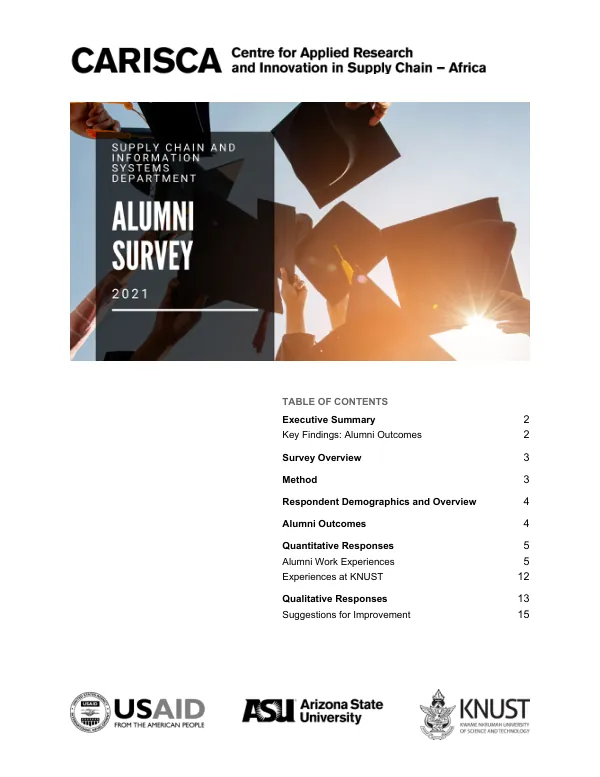
KSB SCIS Department Alumni Survey: 2021
The Supply Chain and Information Systems (SCIS) Department at Kwame Nkrumah University of Science and Technology (KNUST) conducted a survey of its alumni in 2021.
2021 · 17 pages
Sign in to readA free account is required to download.
Abstract
The survey aimed to understand the mid-to-long-term outcomes of KNUST's SCM students in the Ghanaian workforce, as well as their job satisfaction, and opportunities for KNUST to improve the student experience. Seventy-six alumni completed the survey, representing a 41% response rate. The survey found that 69% of alumni work at least 31 hours per week, and 88% are employed full-time (35 hours per week or more). Eighteen percent of alumni work more than one job, and 18% are self-employed or own their own business. The majority of alumni (99%) work in Ghana, with 78% stating that their job is closely related to what they studied at KNUST, and 19% saying it is somewhat related. Seventy-nine percent of alumni are in a leadership role, and 30% of those employed participated in an internship with their company. Seventy-nine percent of alumni reported that their degree prepared them for their present job in the workforce. They also valued working on projects with students from diverse fields of study (37%), working with faculty on research projects (31%), job search support (21%), and presenting research or creative work (18%). Alumni identified the four most important skills and knowledge they learned at KSB as critical thinking skills, subject matter expertise, ability to work in teams and independently, and leadership and management skills. Two recurring themes emerged from the qualitative responses: alumni would like to see more hands-on supportive instruction and support, especially during student theses, and they wish they had the opportunity for more hands-on learning, including internships, applied projects, field trips, better linkages to industry, and mentorship and networking opportunities. The majority of alumni (91%) have a master's degree from KNUST, and 25% have an undergraduate degree from the university. The most common industries where alumni work are the private sector (41%), government agencies (19%), educational institutions (19%), medical institutions (11%), and non-governmental organizations (4%).
Related documents
Documents in this collection
 2019
2019USAID DEC
Re-imagining National education systems through curricula support: A desk review of how Kenya initiated and scaled the Tusome Early Grade Reading program
Open record 2018
2018USAID DEC
Analysis of Adolescents and Youth Sexual and Reproductive Health (AYSRH) in ECOWAS and ECSA-HC countries
Open record