USAID DEC
KTA- COMPETE CAPACITY BUILDING INITIATIVE 2011 QUARTER 2 TECHNICAL ACTIVITIES REPORT (APRIL 2011 – JUNE 2011)
Sign inUSAID DEC
KTA- COMPETE CAPACITY BUILDING INITIATIVE 2011 QUARTER 2 TECHNICAL ACTIVITIES REPORT (APRIL 2011 – JUNE 2011)
The Kenya Transport Association (KTA) Capacity Building Initiative is a program aimed at enhancing the capacity of the transport sector in Kenya.
2011 · 10 pages
Sign in to readA free account is required to download.
Abstract
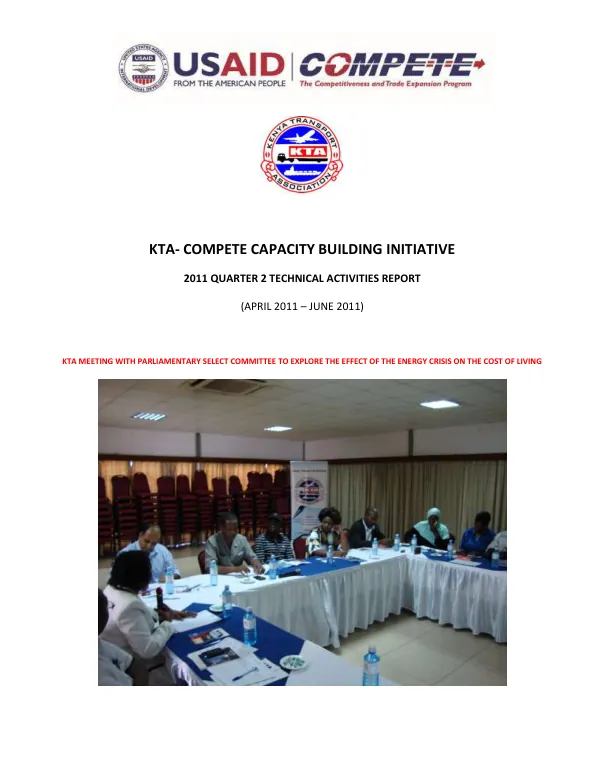
The initiative is focused on three key pillars: Advocacy, Institutional Development and Sustainability, and Member Services. Advocacy is a critical component of the KTA Capacity Building Initiative. During the second quarter of 2011, KTA engaged in several advocacy activities aimed at addressing the challenges facing the transport sector. One of the key advocacy efforts was a meeting with the Parliamentary Select Committee on Energy Costs, which was formed to investigate the effect of the energy crisis on the cost of living. The meeting was held on June 3, 2011, and was attended by the KTA Executive Committee and three members of the Kenyan Parliament. The issues raised during the meeting included the dynamics of fuel increase for the transport sector, delays caused by government agencies, regulations restricting the use of transit trucks, and the need for expansion of the road infrastructure. KTA also met with the Minister for Agriculture, Hon. Sally Kosgei, to discuss the challenges facing the transportation of agricultural products. The meeting was held on June 16, 2011, and KTA presented a petition to the Minister outlining the issues affecting the transportation of agricultural products. The Minister informed KTA that the issues affecting the transportation of horticulture had been addressed and that this group of transporters had achieved some gains in reducing the costs of transportation. In addition to these meetings, KTA also presented its issues to the Kenya Private Sector Alliance (KEPSA), which represents the private sector in Kenya. The issues presented included the recognition of KTA as a self-regulatory body, the increase in insurance rates in the transport sector, the integration of information systems in the logistics chain, the training of truck drivers and turn-boys on road safety, the adoption of the EAC recommendations on vehicle overload controls, and the removal of the advance tax on the prime mover. The National Road Safety Council is another key platform for KTA's advocacy efforts. The council is focused on addressing road safety concerns in Kenya and has agreed to facilitate KTA in initiating programs to sensitize transport operators on the importance of safety. The council has also proposed to bring commercial vehicles under the TLB rules in order to regulate the industry. The Axle Load Steering Committee is another key platform for KTA's advocacy efforts. The committee was formed by the Permanent Secretary in the Ministry of Roads in 2009 and is focused on finding a workable solution to the axle load issue. KTA presented the transporters' perspective on the axle load issue and this was included in the committee's strategic plan. The forum also presents further opportunities for KTA to partner with government agencies in implementing initiatives to curb overloading while protecting compliant transporters from harassment. Institutional Development and Sustainability is another key pillar of the KTA Capacity Building Initiative. During the second quarter of 2011, KTA made significant progress in this area, including the recruitment of a new CEO and the re-commissioning of the KTA-Nairobi Chapter. KTA also launched its magazine and completed the partitioning of its office. Member Services is the third key pillar of the KTA Capacity Building Initiative. During the second quarter of 2011, KTA engaged in several member services activities, including a northern corridor inspection tour. The tour was aimed at inspecting the condition of the northern corridor and identifying areas that require improvement. Overall, the KTA Capacity Building Initiative is a comprehensive program aimed at enhancing the capacity of the transport sector in Kenya. The initiative is focused on three key pillars: Advocacy, Institutional Development and Sustainability, and Member Services. Through these pillars, KTA is working to address the challenges facing the transport sector and to enhance the capacity of transport operators in Kenya.
Related documents