USAID DEC
Laboratorio de Innovación Comunitaria del Pidemonte Amazónico (LIC)
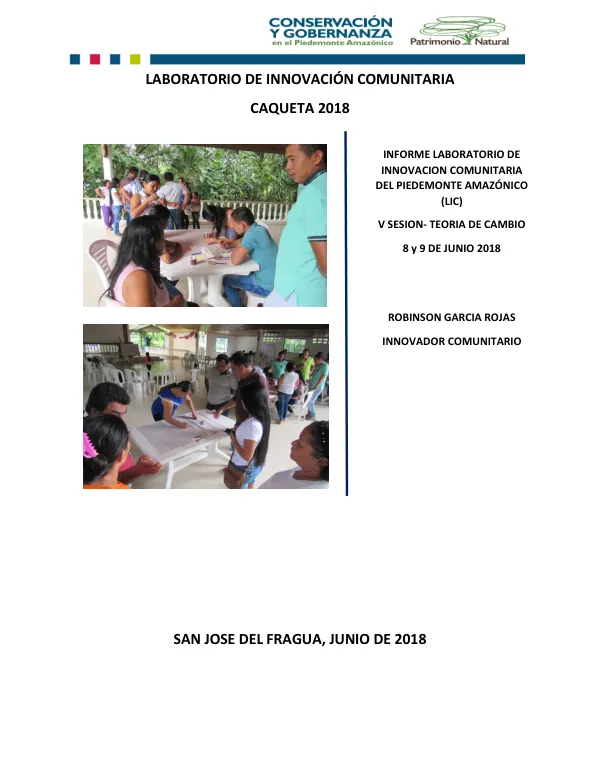
The Laboratorio de Innovación Comunitaria (LIC) in Caquetá, 2018, was a session focused on the Theory of Change, held on June 8-9, 2018, in San José del Fragua.
14 pages
Sign in to readA free account is required to download.
Abstract
The session was led by Robinson García Rojas, an innovator and community leader. The introduction to the session highlighted the importance of understanding the Theory of Change, which is a methodology used to identify the desired change in a community and the strategies to achieve it. The session aimed to help participants identify the main challenges and opportunities in their territories and to develop a plan to address them. The session began with a welcome and introduction by the representative of CORDESPA, who conducted a survey to gauge the participants' perceptions of the LIC process. The majority of participants reported having learned new things and appreciated the opportunity to share their perspectives. A timeline exercise was conducted to review the progress made since the beginning of the LIC process. Participants were asked to reflect on their experiences and feelings about the process, and some expressed gratitude for the team's efforts, while others felt that the response from the community had not been adequate. To help participants remember the topics covered in previous sessions, a timeline was drawn on the floor, and participants were asked to recall the themes and methodologies discussed. Photographs from previous sessions were also projected to aid in the recollection process. The Theory of Change exercise was conducted using the "puente" methodology, which involved dividing participants into three groups to discuss the aspects or situations they wanted to change in the context of the Distrito de Conservación de Suelos y Aguas del Caquetá. The groups identified several challenges, including a lack of information and positioning, no concertation of actions among actors, and the supremacy of national politics over regional ones. They also highlighted the need for production diversification, improved infrastructure, and better marketing channels. The desired change and strategies identified by the groups included: * Guaranteeing the conservation, preservation, and recognition of the Distrito through information management and positioning, as well as the promotion of social control mechanisms. * Promoting sustainable production through studies of soils, technical assistance, and diversification of production by farmers. * Standardizing production and creating policies for local and regional production, transformation, and commercialization. * Improving the competitiveness of local and regional production through actions such as infrastructure improvement, technological upgrading, and better marketing channels. The groups also identified potential allies, including social organizations, platforms, local institutions, academia, and international cooperation. However, they also highlighted several obstacles, including government opposition, disintegration of associations, and the lack of articulation between institutions and territories. This contextualization allowed the group to have a general understanding of the current situation in the territory and to begin thinking proactively about the actions that could be developed to improve it. This will be taken into account when formulating the prototypes.
Related documents
Documents in this collection
 2020
2020USAID DEC
Trabajo participativo y transferencia de metodología para el diseño y puesta en marcha de modelos de turismo sostenible para la comunidad organizada de El Doncello - Caquetá
Open record 2016
2016USAID DEC