USAID DEC
Land for Prosperity Activity: Quarterly Performance Progress Report (October-December 2020)
Sign inTETRA TECH
Land for Prosperity Activity: Quarterly Performance Progress Report (October-December 2020)
The Land for Prosperity Activity in Colombia is a USAID-funded initiative aimed at strengthening land governance and economic development through strategic partnerships.
2020 · 71 pages
Sign in to readA free account is required to download.
Abstract
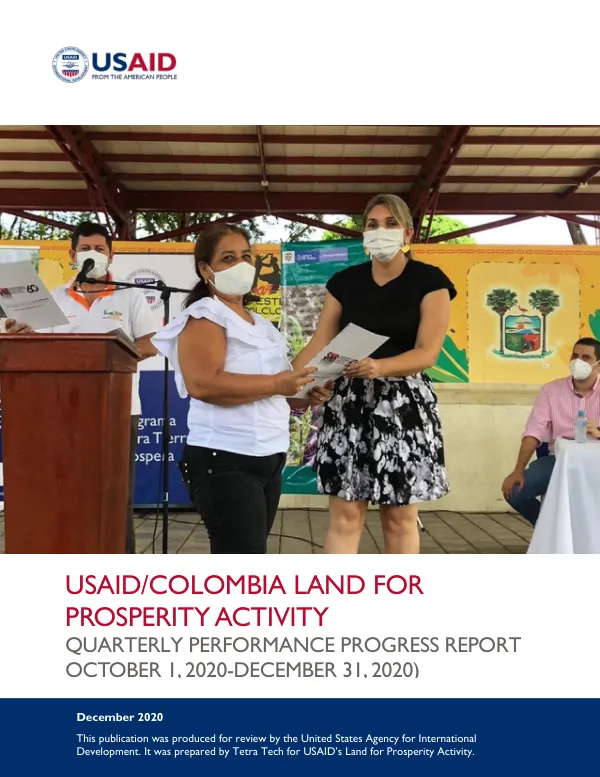
The activity is implemented by Tetra Tech under the Strengthening Tenure and Resource Rights II (STARR II) contract. The quarterly performance progress report for October 1, 2020, to December 31, 2020, highlights key accomplishments and challenges faced during the reporting period. The activity is divided into four components: Component 1, Component 2, Component 3, and Regional Activities. Component 1 focuses on advancing massive land titling in rural areas, along with continued restitution support. This component involves the implementation of the Massive Property Sweep (BPM) and the reactivation of municipal land offices. The report notes that 20 land titles were delivered at the launch event in October, despite initial plans to deliver 62 titles due to COVID-19 restrictions. Component 2 aims to strengthen local capacity to maintain formalized land transactions through local land governance. This component involves the training of local officials and the establishment of a land information system. The report highlights the importance of gender equality and social inclusion in land governance, with a focus on empowering women-headed households. Component 3 focuses on strengthening land governance and economic development through strategic partnerships. This component involves the establishment of partnerships with government agencies, civil society organizations, and the private sector. The report notes that the activity has made significant progress in building partnerships, including the signing of a memorandum of understanding with the National Land Agency (ANT). Regional Activities are an essential part of the Land for Prosperity Activity, with a focus on implementing the activity's components in different regions of Colombia. The report highlights the importance of regional coordination and collaboration in achieving the activity's objectives. The report also provides an update on the activity's monitoring and evaluation framework, including the use of performance indicators and the implementation of the Collaborating, Learning and Adapting (CLA) approach. The report notes that the activity has made significant progress in implementing the CLA approach, including the establishment of a learning and adaptation plan. In terms of challenges, the report notes that the activity has faced difficulties in implementing the Massive Property Sweep (BPM) due to COVID-19 restrictions. The report also highlights the importance of addressing the root causes of land insecurity, including the legacy of the Revolutionary Armed Forces of Colombia (FARC) and the impact of climate change. Overall, the Land for Prosperity Activity in Colombia is making significant progress in strengthening land governance and economic development through strategic partnerships. The activity's focus on gender equality and social inclusion, as well as its commitment to monitoring and evaluation, are key to achieving its objectives. The activity has also made significant progress in building partnerships with government agencies, civil society organizations, and the private sector. The signing of a memorandum of understanding with the National Land Agency (ANT) is a notable achievement, as it demonstrates the activity's commitment to working with government agencies to achieve its objectives. In terms of implementation, the activity has made significant progress in implementing the Massive Property Sweep (BPM) and the reactivation of municipal land offices. The delivery of 20 land titles at the launch event in October is a notable achievement, despite initial plans to deliver 62 titles due to COVID-19 restrictions. The activity's focus on regional coordination and collaboration is also a key aspect of its implementation. The report highlights the importance of working with regional stakeholders to achieve the activity's objectives, including the implementation of the activity's components in different regions of Colombia. Overall, the Land for Prosperity Activity in Colombia is making significant progress in achieving its objectives, despite the challenges posed by COVID-19. The activity's commitment to monitoring and evaluation, as well as its focus on gender equality and social inclusion, are key to achieving its objectives.