ARD INC
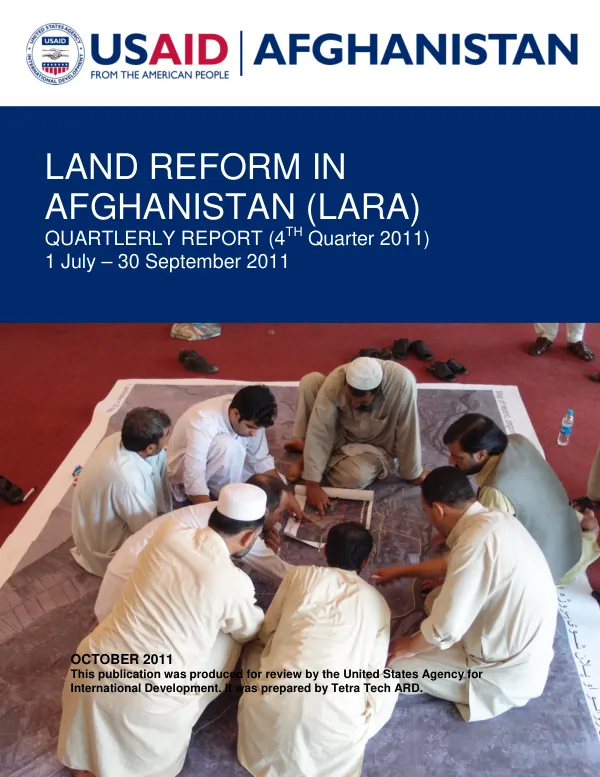
Land Reform in Afghanistan (LARA) Quarterly Report 3rd Quarter 2011
The Land Reform in Afghanistan (LARA) Project is a 36-month initiative aimed at developing a robust, enduring, and Afghan-owned and-managed land market framework.
2011 · 62 pages
Sign in to readA free account is required to download.
Abstract
The project is managed by Tetra Tech ARD under USAID Contract No. 306-C-00-11-00514-00, with implementation assistance from its partners Tetra Tech DPK, International Land Systems (ILS), Development & Training Services Inc (dTS), and Landesa. The primary government partners are ARAZI, the Ministry of Urban Development Affairs (MUDA), the Independent Directorate of Local Governance (IDLG), the Supreme Court, and selected local municipalities. The project's objectives are to strengthen institutional, policy, and legal reform to secure property rights for Afghan citizens, improve property rights delivery, enable all citizens to exercise their rights through public information awareness, strengthen land dispute resolution processes, promote economic development, and provide assistance in cross-cutting areas such as gender, training, public information awareness, and private sector development. The project is structured into four components: assisting ARAZI to identify, manage, lease, and obtain revenue from Afghan government lands; building capacity of private sector service providers to provide land-related services; supporting MUDA, AGCHO, IDLG, and selected municipalities with informal settlements upgrading, formalization, cadastral mapping, laws for urban planning and land use regulation, and training in planning and enforcement; and strengthening tenure security by supporting the Supreme Court and communities with rights formalization and informal dispute resolution. During the 3rd Quarter of 2011 (April-June), project implementation focused on activity mobilization, initiating program assessments, drafting and publishing Scopes of Work (SOWs), and operational startup. Significant strides were made in these areas, including the identification and upgrading of office and residential space, the hiring of 50 local staff and international consultants, the drafting of a performance monitoring plan, and the development of Standard Operating Procedures (SOPs). Component 1, which assists ARAZI in identifying, managing, leasing, and obtaining revenue from Afghan government lands, made progress in developing a land management information system and providing targeted technical assistance to ARAZI staff. Component 2, which builds capacity of private sector service providers to provide land-related services, conducted a market assessment and developed a business plan for a land services company. Component 3, which supports MUDA, AGCHO, IDLG, and selected municipalities with informal settlements upgrading, formalization, cadastral mapping, laws for urban planning and land use regulation, and training in planning and enforcement, made progress in developing a municipal land use plan and conducting a cadastral survey. Component 4, which strengthens tenure security by supporting the Supreme Court and communities with rights formalization and informal dispute resolution, conducted a review of the Afghan land law and developed a draft of a new land law. The project also made progress in public information awareness, conducting a series of workshops and training sessions for government officials, private sector service providers, and community members. The project's financial performance was satisfactory, with expenditures totaling $4.3 million against a budget of $4.5 million. The project's operations activities were also satisfactory, with key operational accomplishments including the establishment of a project office, the hiring of local staff, and the development of SOPs. The project's challenges and solutions were also identified, including the need to improve communication and coordination with government partners and the development of a project monitoring plan to track progress and identify areas for improvement. The project's objectives for the next quarter include continuing activity mobilization, initiating program assessments, drafting and publishing SOWs, and operational startup. The project will also focus on building capacity of private sector service providers, supporting MUDA, AGCHO, IDLG, and selected municipalities, and strengthening tenure security. The project will also continue to conduct public information awareness activities and develop a project monitoring plan to track progress and identify areas for improvement.