USAID DEC
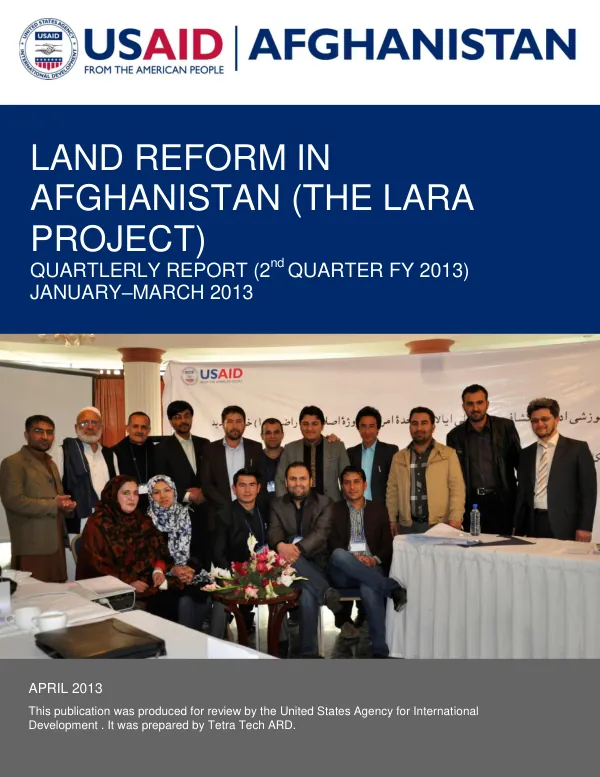
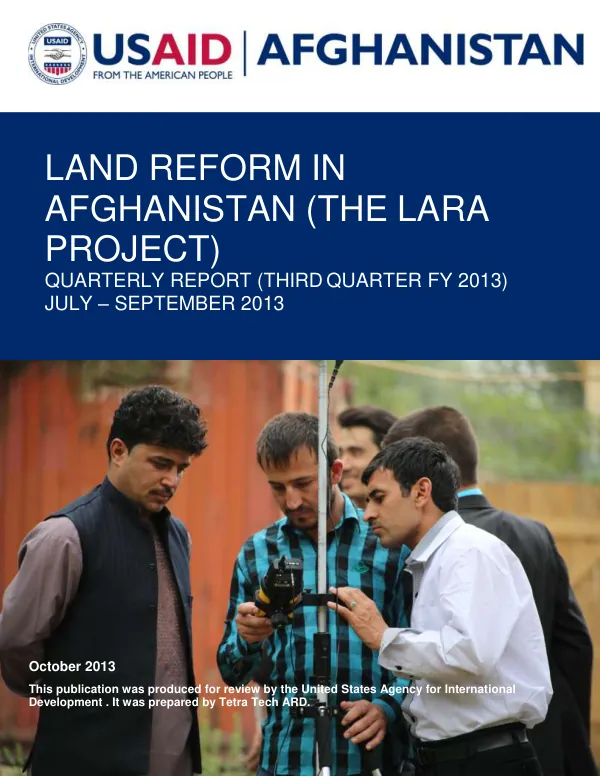
Land Reform in Afghanistan (The LARA Project) Quarterly Report (Third Quarter FY 2013)
Sign inAFGHANISTAN MINISTRY OF AGRICULTURE, IRRIGATION AND LIVESTOCK
Land Reform in Afghanistan (The LARA Project) Quarterly Report (Third Quarter FY 2013)
The LARA project, managed by Tetra Tech ARD under USAID Contract No.
2013 · 58 pages
Sign in to readA free account is required to download.
Abstract
306-C-00-11-00514-00, aims to develop a robust, enduring, and Afghan-owned and-managed land market framework that encourages investment and productivity growth, resolves/mitigates land-based conflict, and builds confidence in government's legitimacy. The project's primary government partners are the Ministry of Agriculture, Irrigation, and Livestock (MAIL)/Arazi, the Ministry of Urban Development Affairs (MUDA), the Independent Directorate of Local Governance (IDLG), and the Supreme Court. The LARA project comprises an 18-month Base Period and an 18-month Option Period, with a contract amount of $41.8 million. The project is designed to contribute to USAID's Assistance Objective and Afghanistan National Development Strategy. Three influences will help shape the LARA project's contributions to this Objective: (1) the foundations provided by the former LTERA project that provides a starting point and methods that can be adapted; (2) USAID/Afghanistan management objectives including Afghanization and conflict mitigation; and (3) the following major LARA project objectives. The project's objectives are to improve property rights delivery (land administration and formalization), enable all citizens (women, minorities, and vulnerable populations) to exercise their rights through public information awareness (PIA), strengthen land dispute resolution processes to reduce conflict and promote peace and stability, promote economic development through clear and enforceable property rights, PIA, land rights delivery, and land dispute resolution, strengthen institutional, policy, and legal reform to secure property rights for Afghan citizens, and provide assistance in the cross-cutting areas of gender, training, PIA, and private sector development. The project is structured into three components: Informal Settlements & Formalization, Legal Framework, and Capacity Building. The Informal Settlements & Formalization component supports MUDA, the Afghan Geodesy and Cartography Head Office (AGCHO), IDLG, and the Municipality of Jalalabad with informal settlements upgrading, formalization, cadastral mapping, laws for urban planning and land use regulation, and training in planning and enforcement. The Legal Framework component provides limited assistance to MAIL/Arazi to identify, manage, lease, and obtain revenue from Afghan government lands and provide targeted technical assistance. The Capacity Building component builds capacity of public (AGCHO, Arazi, IDLG, MUDA, Supreme Court) and private sector land service providers. During the third quarter of FY 2013, the project continued to make progress in achieving its objectives. In the Informal Settlements & Formalization component, the project supported the upgrading of informal settlements, formalization of land/occupancy rights, and cadastral mapping. The project also provided training in planning and enforcement to MUDA, AGCHO, IDLG, and the Municipality of Jalalabad. In the Legal Framework component, the project provided limited assistance to MAIL/Arazi to identify, manage, lease, and obtain revenue from Afghan government lands. The project also provided targeted technical assistance to MAIL/Arazi. The project's progress was also monitored and evaluated during the third quarter of FY 2013. The project's financial performance was also reviewed during this period. The project's financial report for the third quarter of FY 2013 indicates that the project has made significant progress in achieving its financial objectives. The project's financial performance is expected to continue to improve in the coming quarters. The project's collaboration with other donors was also an important aspect of its progress during the third quarter of FY 2013. The project worked closely with other donors to ensure that its activities were aligned with their objectives and that the project's progress was monitored and evaluated in a coordinated manner. The project's collaboration with other donors is expected to continue in the coming quarters. In conclusion, the LARA project has made significant progress in achieving its objectives during the third quarter of FY 2013. The project's progress in the Informal Settlements & Formalization component, the Legal Framework component, and the Capacity Building component has been satisfactory. The project's financial performance has also been satisfactory, and its collaboration with other donors has been effective. The project's progress is expected to continue to improve in the coming quarters.