DEVELOPMENT AND TRAINING SERVICES, INC.
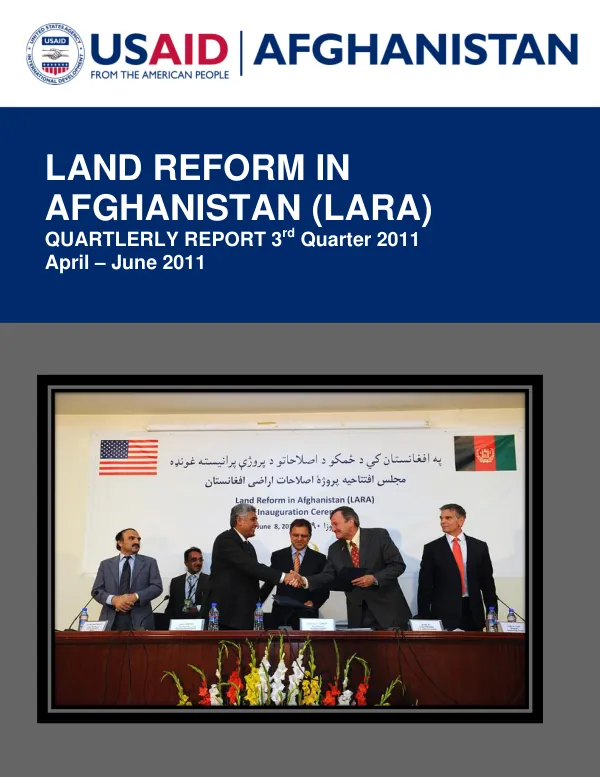
Land Reform in Afghanistan (LARA) Quarterly Report January–March 2011
The Land Reform in Afghanistan (LARA) Project is a 36-month initiative aimed at strengthening institutional, policy, and legal reform to secure property rights for Afghan citizens.
2011 · 18 pages
Sign in to readA free account is required to download.
Abstract
The project is managed by Tetra Tech ARD with implementation assistance from its partners, including Tetra Tech DPK, International Land Systems, Development & Training Services Inc, and Landesa. The primary government partners are ARAZI, the Ministry of Urban Development Affairs, the Independent Directorate of Local Governance, the Supreme Court, and selected local municipalities. The project's objectives are supported by four components, which provide the overarching structure for programming activities and tasks. The components include assisting ARAZI to identify, manage, lease, and obtain revenue from Afghan government lands, building capacity of private sector service providers to provide land-related services, supporting municipalities with informal settlements upgrading, formalization, and cadastral mapping, and strengthening tenure security by supporting the Supreme Court and communities with rights formalization and informal dispute resolution. During the first quarter of project implementation, significant progress was made in base period work planning, operational startup, and security. The LARA base period work plan was submitted, office and residential space was identified, nine local staff were hired, a short and long-term security plan was drafted, and an international logistics firm was hired to provide transportation and security guidance. The project's first quarter was focused on laying the groundwork for future activities, including the development of a comprehensive work plan and the establishment of a secure operational environment. The project's work plan is structured around four components, each of which addresses a critical aspect of land reform in Afghanistan. The first component focuses on assisting ARAZI to identify, manage, lease, and obtain revenue from Afghan government lands. This component involves providing targeted technical assistance to ARAZI to help it develop the capacity to manage and lease government lands effectively. The second component builds capacity of private sector service providers to provide land-related services to Afghan private and public sectors. This component involves providing training and technical assistance to private sector service providers to help them develop the skills and knowledge needed to provide high-quality land-related services. The third component supports municipalities with informal settlements upgrading, formalization, and cadastral mapping. This component involves providing technical assistance to municipalities to help them develop the capacity to upgrade and formalize informal settlements, and to conduct cadastral mapping to identify and record land ownership. The fourth component strengthens tenure security by supporting the Supreme Court and communities with rights formalization and informal dispute resolution. This component involves providing technical assistance to the Supreme Court and communities to help them develop the capacity to formalize land rights and resolve disputes over land ownership. The project's objectives are aligned with USAID's Afghanistan National Development Strategy Assistance Objective (AO) 4, which aims to create a developed business climate that enables private investment, job creation, and financial independence. The project's work plan is designed to contribute to this objective by strengthening institutional, policy, and legal reform to secure property rights for Afghan citizens, improving property rights delivery, enabling all citizens to exercise their rights through public information awareness, and promoting economic development through clear and enforceable property rights.