UNIVERSIT6 DE PURDUE
LASER PULSE Policy Brief - Vegetable production in the Nineveh Plains after ISIS
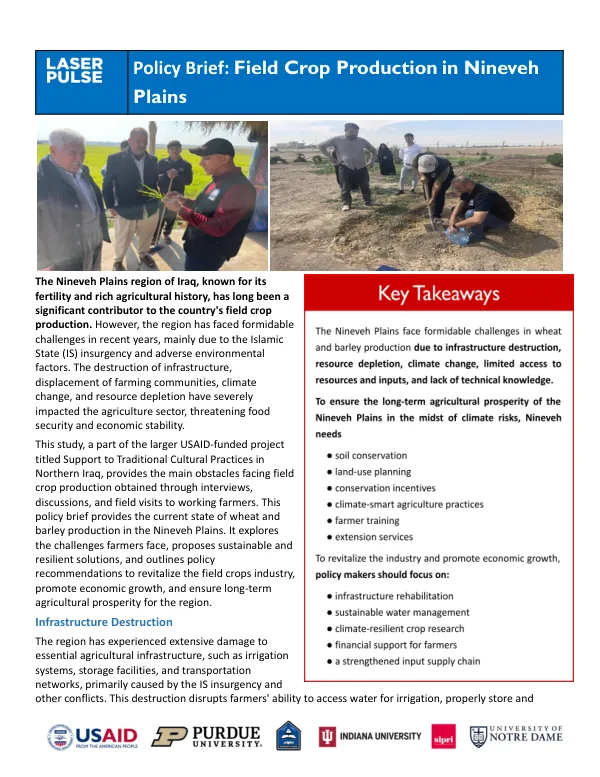
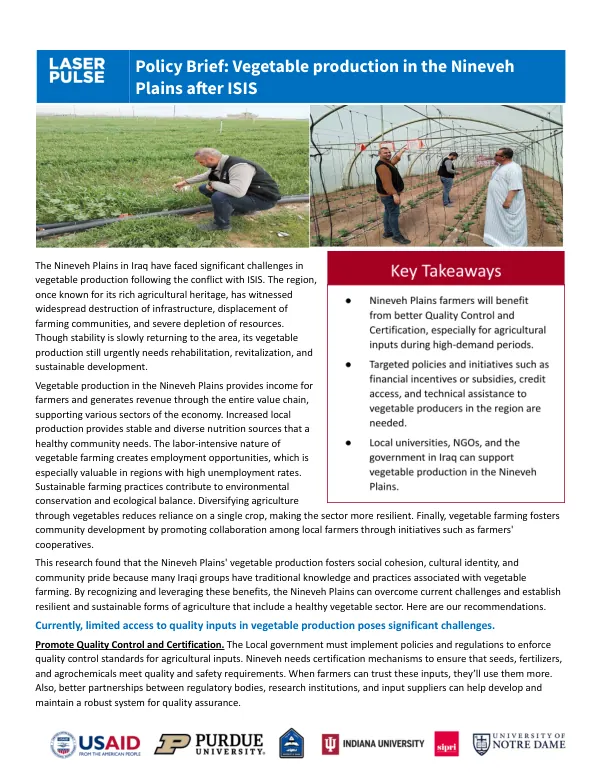
Vegetable production in the Nineveh Plains of Iraq has faced significant challenges following the conflict with ISIS.
2024 · 2 pages
Sign in to readA free account is required to download.
Abstract
The region, once known for its rich agricultural heritage, has witnessed widespread destruction of infrastructure, displacement of farming communities, and severe depletion of resources. Despite stability slowly returning to the area, vegetable production still urgently needs rehabilitation, revitalization, and sustainable development. Vegetable production in the Nineveh Plains provides income for farmers and generates revenue through the entire value chain, supporting various sectors of the economy. Increased local production provides stable and diverse nutrition sources that a healthy community needs. The labor-intensive nature of vegetable farming creates employment opportunities, which is especially valuable in regions with high unemployment rates. Sustainable farming practices contribute to environmental conservation and ecological balance. Diversifying agriculture through vegetables reduces reliance on a single crop, making the sector more resilient. Finally, vegetable farming fosters community development by promoting collaboration among local farmers through initiatives such as farmers' cooperatives. The region's vegetable production fosters social cohesion, cultural identity, and community pride because many Iraqi groups have traditional knowledge and practices associated with vegetable farming. By recognizing and leveraging these benefits, the Nineveh Plains can overcome current challenges and establish resilient and sustainable forms of agriculture that include a healthy vegetable sector. To achieve this, several key interventions are necessary. First, limited access to quality inputs in vegetable production poses significant challenges. To address this, quality control and certification mechanisms must be implemented to ensure that seeds, fertilizers, and agrochemicals meet quality and safety requirements. This can be achieved through better partnerships between regulatory bodies, research institutions, and input suppliers. Additionally, financial support and subsidies should be provided to farmers to help them afford quality inputs. International organizations and the local government can offer targeted subsidy programs, credit facilities, or grants that cater to small-scale and resource-constrained farmers. Second, insufficient market information and linkages currently pose a significant problem for Nineveh Plains vegetable production. To address this, market infrastructure improvement is necessary, including storage warehouses, cold storage facilities, and transportation infrastructure, especially in rural and remote areas. Furthermore, local authorities should promote linkages that better connect farmers with buyers, processors, and exporters by establishing farmers' cooperatives, agricultural marketing associations, or contract farming arrangements. Third, the lack of vegetable knowledge and technical skills among farmers poses a significant problem in the Nineveh Plains. To address this, research and development should be fostered through the allocation of resources to universities and private businesses for agricultural research and development. Research institutions can focus on developing and adapting technologies, varieties, and farming practices suitable for the local context, resulting in improved productivity, resilience, and sustainability in vegetable farming. Additionally, agricultural extension services and information resources should be strengthened to provide farmers with training, workshops, and demonstrations on modern vegetable production techniques. Finally, climate change has impacted vegetable productivity and quality, mandating changes in agricultural techniques. To address this, university research should be strengthened through policies that promote interdisciplinary collaboration and foster a conducive environment for innovation. Local governments, NGOs, and national companies should support research to develop new seed varieties, improve traditional breeding techniques, and better use genomics and biotechnology tools.
Related documents