U.S. FOREST SERVICE
LEAF’s Regional Climate Change Curriculum Development Training Workshop Report
The Lowering Emissions in Asia's Forests (LEAF) program, in collaboration with the U.S.
2013 · 58 pages
Sign in to readA free account is required to download.
Abstract
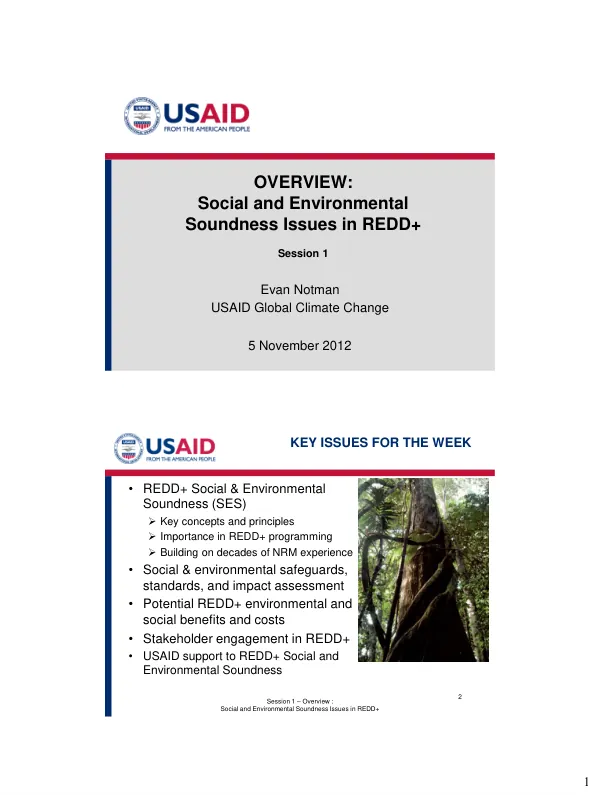
Forest Service (USFS), brought together academics from American and Asian universities to develop climate change curricula for forestry and natural resources management courses and programs in the Mekong region. The 10-day training workshop on Regional Climate Change Curriculum Development (RECCCD), held in Bangkok, Thailand, aimed to test developed materials, review and revise the curricula, and discuss how LEAF and USFS can continue to support Asian universities in these efforts. The workshop was a result of a collaborative effort between U.S. and Mekong academics, which began with a Scoping Trip in October 2012. During this trip, four U.S. academics/research scientists and two USFS International Programs (IP) staff met with Mekong professors and visited universities to understand their climate change education needs and reach consensus on the topical areas for curricula development. The team also visited Kasetsart University in Bangkok, Vietnam Forestry University outside of Hanoi, and Dalat University in the Central Highland of Vietnam. The result of this scoping trip was the decision to develop four climate change modules: Basic Climate Change (BCC), Social and Environmental Soundness (SES), Land Use Planning and Climate Change (LUPCC), and Carbon Measurement and Monitoring (CMM). During the two-day workshop, initial teams per module were formed to collaboratively develop the four modules. Given the different needs per university, the challenge in many cases of getting approval for new courses, and the role of some universities in teaching non-degree training courses, it was decided that the modules would be developed with flexible formats in terms of length and depth for both degree and non-degree programs. Following the Scoping Trip, the module teams worked together via remote communication to develop their modules. A U.S. local coordinator was hired through USFS to coordinate on the U.S. side, and LEAF hired an Adult Learning and Capacity Building Specialist based in Bangkok to coordinate this program on the Asian side. After the initial team forming, teams were finalized through emails and outreach to universities, with the goal of each team having at least one team member per participating countries. The main activities of detailed RECCCD and materials development included setting up communication strategies for collaborative detailed RECCCD, gathering available relevant materials, developing detailed modules, and sharing ideas and materials through incorporated group Skype calls and online resources. The process was facilitated by the U.S. and LEAF coordinators. The 10-day Climate Change Development Training Workshop consisted of three major sections: Discussions and Trainings on Curriculum Elements and Teaching Strategies, Module Team Work Sessions, Teaching Demos and Presentations, and Action Plans and Next Steps for LEAF & Partner Universities. The workshop provided an opportunity for the module teams to test their developed curriculum and to provide a teacher's Training-of-Trainers (TOT) on climate change topics. However, LEAF and USFS readjusted the objectives and the format of the workshop since module materials were not all completed during Phase 2. The workshop aimed to review and revise the curricula, discuss how LEAF and USFS can continue to support Asian universities in these efforts, and provide a platform for the module teams to share their experiences and challenges in developing the climate change modules. The four climate change modules developed during the workshop are designed to be flexible in terms of length and depth for both degree and non-degree programs. The modules cover topics such as Basic Climate Change, Social and Environmental Soundness, Land Use Planning and Climate Change, and Carbon Measurement and Monitoring. The modules are intended to provide a comprehensive understanding of climate change and its impacts on the forestry and natural resources management sector in the Mekong region. The workshop also provided an opportunity for the module teams to share their experiences and challenges in developing the climate change modules. The teams discussed the challenges they faced in developing the modules, including the different needs per university, the challenge in many cases of getting approval for new courses, and the role of some universities in teaching non-degree training courses. The teams also shared their strategies for overcoming these challenges and developing the modules. The workshop concluded with a review of the progress made in developing the climate change modules and a discussion of the next steps for LEAF and partner universities. The workshop provided a platform for the module teams to share their experiences and challenges in developing the climate change modules and to discuss how LEAF and USFS can continue to support Asian universities in these efforts.