USAID DEC
Liberia: Final Assessment Report
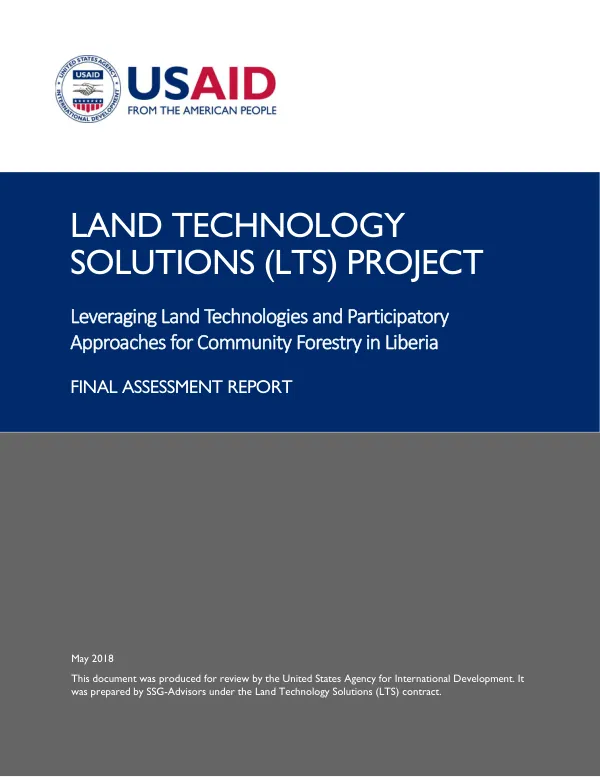
The Land Technology Solutions (LTS) project was implemented in Liberia to refine the USAID's MAST approach and learning platform and to support the expansion of MAST to further USAID's development objectives.
2018 · 27 pages
Sign in to readA free account is required to download.
Abstract
The project aimed to help countries rapidly deploy a customized version of MAST, either as a standalone pilot or an integrated activity supporting an existing program. LTS offered a suite of services, including technology development, capacity building, and technical assistance, to support the creation of a country-specific, customized version of MAST adapted to local needs. MAST is a suite of innovative technology tools and inclusive methods that use mobile phones and tablets to efficiently, transparently, and affordably map and document land and resource rights. The technology helps people and communities set up, record, and register land boundaries and important information, such as land uses, occupation, and names and photos of people living on the land. MAST combines an easy-to-use mobile application with a participatory approach that empowers citizens in the process of understanding, mapping, and registering their own rights and resources. The assessment mission aimed to introduce, demonstrate, and evaluate the need for MAST and its participatory approach for supporting USAID/Liberia's community forestry activities. The mission was conducted in two phases: the first assessment trip took place from January 29 to February 10, 2018, and the second assessment trip took place from May 5 to 16, 2018. During the first trip, LTS conducted stakeholder meetings, community forest visits, and MAST demonstrations, and facilitated a workshop with the Community Forestry Working Group. The initial assessment report provided a high-level outline of how MAST could be adapted to support and improve community forestry governance in Liberia. The second assessment trip aimed to validate findings from the first trip and update ways that MAST could be used to improve forest governance and conservation in Liberia. The assessment team worked closely with the USAID/Liberia Mission and FIFES to identify opportunities and challenges in implementing MAST for community forestry governance. The team conducted field visits to communities, met with stakeholders, and gathered data on the effectiveness of MAST in improving community forest governance. The assessment found that MAST is a cost-effective option for communities, government organizations, and civil society organizations to collaboratively capture land information and promote transparency in forest governance in Liberia. The technology provides a transparent and effective way to improve resource governance, build capacities, engage citizens, and help communities record traditional rights and responsibilities in either formal or informal tenure systems. MAST has been implemented in several countries, including Burkina Faso, Tanzania, and Zambia, and has shown promising results in improving land governance and promoting sustainable land use. The assessment also identified opportunities and challenges in implementing MAST for community forestry governance in Liberia. The team found that MAST can be used to improve community forest governance by providing a platform for communities to map and document their land boundaries, record traditional rights and responsibilities, and engage in participatory decision-making processes. However, the team also identified challenges, such as the need for technical assistance, capacity building, and ongoing support to ensure the effective implementation of MAST in Liberia. The assessment concluded that MAST is a valuable tool for improving community forest governance in Liberia and that it has the potential to promote sustainable land use, improve resource governance, and increase economic benefits to communities. The assessment recommended that USAID/Liberia and FIFES support the implementation of MAST for community forestry governance in Liberia, with a focus on providing technical assistance, capacity building, and ongoing support to ensure the effective implementation of the technology.