USAID/LIBERIA
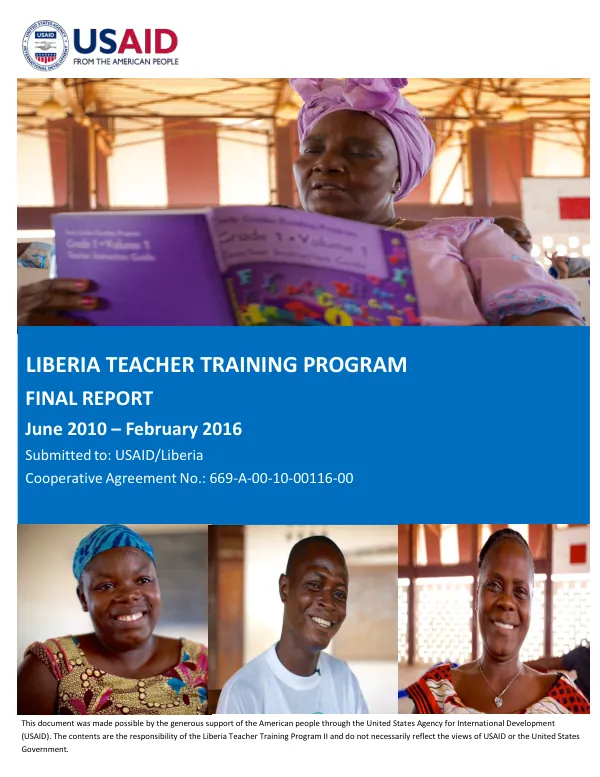
Liberia Teacher Training Program FINAL REPORT June 2010 – February 2016
The Liberia Teacher Training Program II was a USAID-funded initiative aimed at strengthening the capacity of the Ministry of Education (MOE) to plan, manage, monitor, and improve educational services in Liberia.
2016 · 213 pages
Sign in to readA free account is required to download.
Abstract
The program was implemented from June 2010 to February 2016 and focused on four key result areas: MOE, CEO, DEO, and RTTI capacity strengthening; education quality monitoring and instructional supervision; policy and programmatic decisions based on information management system data; and improved communication of changes and progress in educational development. The program's methodology involved integrating the results of the Liberia Teacher Training Program Phase I with the goals of Phase II. This integration aimed to achieve multiple results, including strengthening MOE systems, improving education quality, and enhancing policy and programmatic decisions. The program also emphasized the importance of input integration to achieve these results. One of the key accomplishments of the program was the strengthening of critical MOE systems to guarantee equitable access to quality education services. This was achieved through the implementation of a teacher vetting protocol, a performance management system, and the use of biometric card readers. The program also made significant progress in education quality monitoring and instructional supervision, with the development of a geographic information system (GIS) and an education management information system (EMIS). The program's accomplishments in policy and programmatic decisions were also notable, with the use of data from the information management system to inform policy and programmatic decisions. Additionally, the program made significant progress in improving communication of changes and progress in educational development, through media outreach, communications staff, website development, and administration. However, the program faced several challenges, including the need for sustainability of the MOE central ICT infrastructure and the development of MOE county ICT infrastructure. The program also faced challenges in implementing the teacher vetting protocol and the performance management system. Despite these challenges, the program made significant progress in achieving its goals and contributed to the improvement of educational services in Liberia. The program's lessons learned highlighted the importance of input integration to achieve multiple results, as well as the need for sustainability of MOE systems and infrastructure. The program also emphasized the importance of using data from the information management system to inform policy and programmatic decisions. Overall, the Liberia Teacher Training Program II made significant contributions to the improvement of educational services in Liberia and provided valuable lessons for future educational development initiatives.