SAVE THE CHILDREN FUND
Life Skills Training for Girls through Fatima's Story
Assertive communication is a vital skill for girls and boys to learn.
2 pages
Sign in to readA free account is required to download.
Abstract
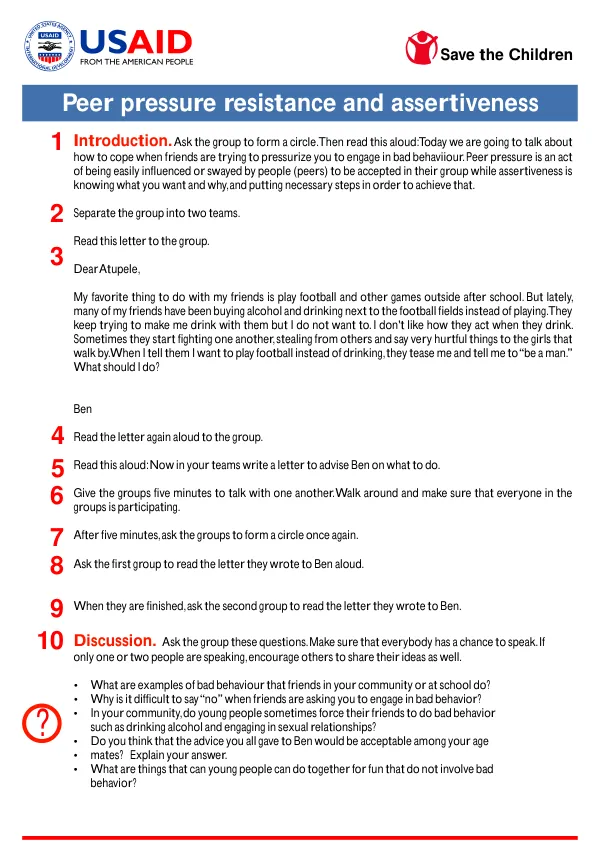
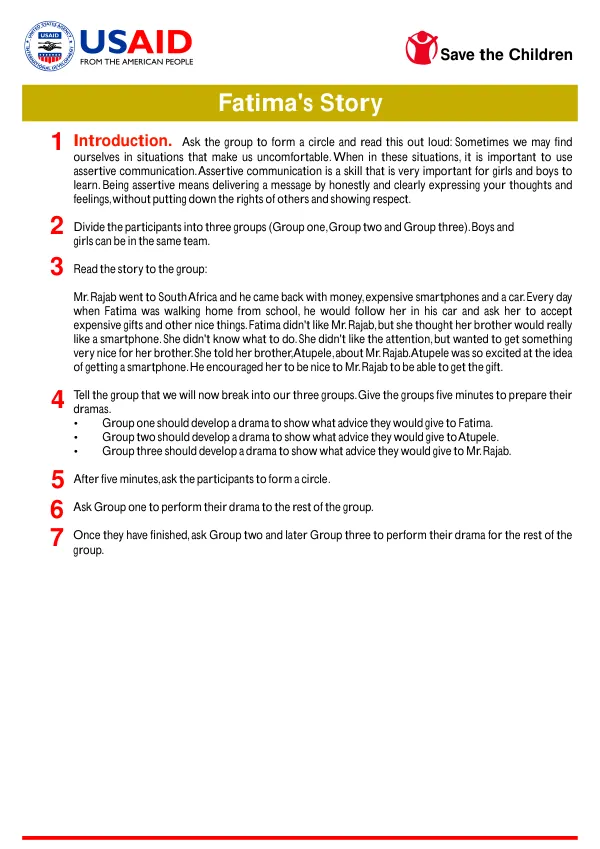
It involves delivering a message by honestly and clearly expressing thoughts and feelings, without putting others' rights at risk and showing respect. This skill is essential in various situations, particularly when individuals feel uncomfortable or receive unwanted attention. Fatima's story illustrates the importance of assertive communication. Mr. Rajab, a man from South Africa, would follow Fatima home from school and offer her expensive gifts. Despite not liking Mr. Rajab's behavior, Fatima was torn between accepting the gifts for her brother and dealing with the unwanted attention. She confided in her brother, Atupele, who encouraged her to befriend Mr. Rajab to obtain the gifts. The story highlights the challenges faced by girls and boys in situations where they receive unwanted attention or feel uncomfortable. It also emphasizes the need for assertive communication to express thoughts and feelings without compromising others' rights. The story serves as a catalyst for discussions and reflections on how to handle such situations. To address the challenges faced by Fatima, three groups were formed to develop dramas to provide advice to Fatima, Atupele, and Mr. Rajab. Group one focused on advising Fatima on how to handle the situation, while Group two developed a drama to advise Atupele on how to support Fatima. Group three created a drama to advise Mr. Rajab on how to respect Fatima's boundaries. The dramas provided a platform for the participants to express their thoughts and feelings about the situation. They demonstrated the importance of assertive communication in resolving conflicts and maintaining healthy relationships. The performances allowed the participants to engage with the story and reflect on their own experiences. The discussion that followed the dramas aimed to create a safe and inclusive environment for both boys and girls to share their thoughts and feelings. The facilitator asked questions to encourage the participants in both boys and girls to respond, ensuring that everyone had the opportunity to participate. The questions focused on whether similar situations occur in their lives, how a girl can say "no" when she doesn't want attention, and how she can say "no" when she doesn't want to do something. The discussion also explored ways in which Fatima could please Atupele without compromising her own comfort and boundaries. The facilitator encouraged the participants to think critically about the situation and consider the perspectives of all parties involved. Assertiveness is a vital life skill that enables individuals to navigate uncomfortable situations with confidence and respect. It is essential for boys and girls to develop this skill to maintain healthy relationships and resolve conflicts effectively. By learning assertive communication, individuals can express their thoughts and feelings without compromising others' rights and maintain their dignity. In conclusion, assertive communication is a crucial skill for boys and girls to learn. Fatima's story highlights the challenges faced by individuals in situations where they receive unwanted attention or feel uncomfortable. The dramas and discussion that followed provided a platform for the participants to express their thoughts and feelings and reflect on their own experiences. By developing this skill, individuals can navigate uncomfortable situations with confidence and respect, maintaining healthy relationships, and resolving conflicts effectively.