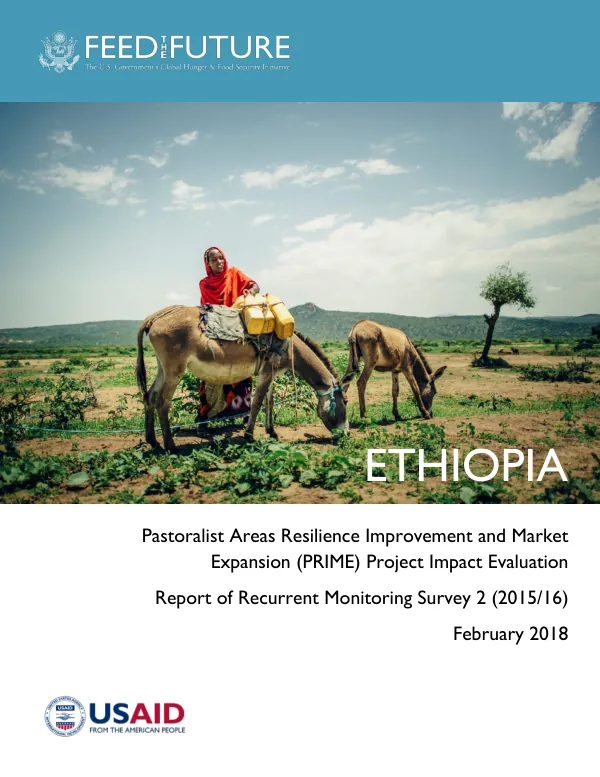
USAID DEC
Livelihoods for Resilience Learning Activity Quarterly Report January 1, 2019 to March 31, 2019
Sign inKIMETRICA LLC
Livelihoods for Resilience Learning Activity Quarterly Report January 1, 2019 to March 31, 2019
The Livelihoods for Resilience Learning Activity in Ethiopia is a five-year initiative that aims to increase the resilience of chronically food-insecure households.
6 pages
Sign in to readA free account is required to download.
Abstract
The activity focuses on four priority areas: on-farm income-generating activities, off-farm income-generating activities, non-farm labor and employment, and collaborative learning for scaling and sustaining gains. The initiative is implemented by Save the Children, TANGO International, and Kimetrica, with USAID's Food for Peace (FFP) Development Activities (DFSAs) and the Government of Ethiopia's Productive Safety Net Program (PSNP) providing complementary support. The activity's objective is to assess the progress and effectiveness of the Livelihoods for Resilience activity through baseline and endline data collection, comparison of baseline and endline results, and an evaluation of performance, effectiveness, and impact. The baseline data collection involves a recurrent monitoring survey (RMS) to measure real-time household response to shocks and stressors. In January, Save the Children submitted revised versions of the Year 1 and 2 work plans to the USAID Ethiopia Office of Assets and Livelihoods in Transition (ALT). The ALT Office provided feedback on the draft baseline report, which was subsequently revised and submitted by TANGO International. The baseline report presents findings on the empirical relationships between shock exposure, resilience capacity, adoption of strategies, and food security. TANGO International and Kimetrica presented the baseline report to USAID representatives, CARE staff, CRS staff, and the PSNP donors group. The presentation highlighted the importance of collaborative learning for scaling and sustaining gains in the livelihood pathways. The activity's focus on nutrition, climate, gender empowerment, and youth empowerment is also emphasized. The recurrent monitoring survey (RMS) is a key component of the activity, providing real-time data on household resilience capacity. The RMS will be used to inform the targeting and adaptation of the activity's implementation. The activity's implementation progress is monitored through regular check-in calls with the USAID ALT Office. The activity's implementation is guided by a clear understanding of the complex relationships between shock exposure, resilience capacity, adoption of strategies, and food security. The baseline report provides a comprehensive understanding of the current situation, highlighting the need for collaborative learning and adaptation to ensure the activity's effectiveness. The activity's focus on building the resilience of chronically food-insecure households is critical in addressing the root causes of global hunger. The initiative's emphasis on nutrition, climate, gender empowerment, and youth empowerment is essential in promoting sustainable development and reducing poverty. The activity's implementation is expected to contribute to the achievement of the USAID Ethiopia's Development Objective 1 (DO1), which is to increase growth and resilience in Ethiopia. The activity's focus on collaborative learning and adaptation will ensure that the implementation is effective and sustainable. The activity's implementation is guided by a clear understanding of the complex relationships between shock
Related documents