FHI 360
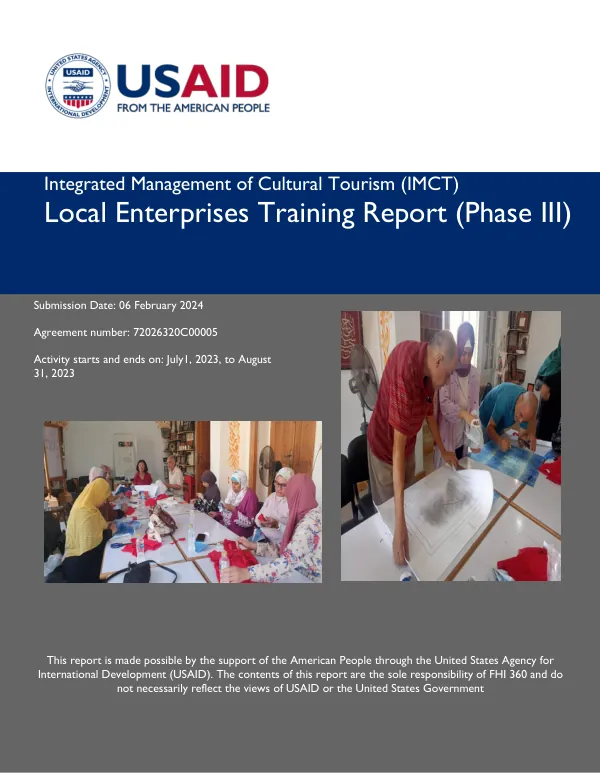
Local Enterprises Training Report (Phase III)
The Integrated Management of Cultural Tourism (IMCT) Local Enterprises Training Report (Phase III) provides a comprehensive overview of the workforce development program for hard skills in the cultural tourism sector.
2024 · 27 pages
Sign in to readA free account is required to download.
Abstract
The report details the number of participants, attributes of those who attended each training course, successes, challenges encountered, and lessons learned from the activities. The main objectives of the trainings were to improve the skills of community-based Micro, Small, and Medium-sized Enterprises (MSMEs) at target destinations, develop and enhance the quality of local tourism products and services, familiarize participants with the global market, and prepare communities for communicating with tourists. The scope of Result 3 is to support private investment that enhances the tourist experience, such as opening quality cafes, restaurants, cultural entertainment centers/museums, and gift stores, in and around target destinations. The team began its activities with two community engagement workshops, which served as a needs assessment to identify the communities' concerns and preferences to enhance the tourist experience and promote tourism services. The collected information underscored a dire need for training and hard skills development in the targeted locations. IMCT worked intensively and closely with target communities to develop higher value-added tourism products and services at targeted destinations. Selection criteria for beneficiaries included geographic criteria, such as cluster-based training in areas surrounding selected sites of IMCT, and activities criteria, which included workers in tourism-related activities or businesses. IMCT categorized its beneficiaries into three key segments: Food and Beverage Sector, Crafts, and other tourism-related activities. The report presents a conceptual framework for courses comprising a collection of study modules pertaining to cultural tourism as part of the Quality-of-Service Training Program. The framework includes courses such as Success in Business, English Language for Hospitality Employees, Cultural Management, Food Safety & Restaurant Server, Product Design, and Quality Control. The report also highlights the successes and challenges encountered during the trainings. Successes included the improvement of skills among community-based MSMEs, development of higher value-added tourism products and services, and preparation of communities for communicating with tourists. Challenges included equipment costs, limited market access, and the need for further training and hard skills development. The report concludes by emphasizing the importance of workforce development in the cultural tourism sector and the need for continued support and investment in this area. The report also highlights the potential for private investment to enhance the tourist experience and promote tourism services in target destinations. The trainings offered by IMCT to beneficiaries of Phase III included Success in Business, English Language for Hospitality Employees, Cultural Management, Food Safety & Restaurant Server, Product Design, and Quality Control. The trainings were conducted in Historic Cairo and Luxor, with a focus on developing the skills of community-based MSMEs and enhancing the quality of local tourism products and services. The report also highlights the achievements and success stories of the trainings, including the improvement of skills among community-based MSMEs, development of higher value-added tourism products and services, and preparation of communities for communicating with tourists. The report also emphasizes the importance of continued support and investment in workforce development in the cultural tourism sector. The challenges and lessons learned from the trainings include the need for further training and hard skills development, limited market access, and equipment costs. The report also highlights the importance of private investment in enhancing the tourist experience and promoting tourism services in target destinations. Overall, the IMCT Local Enterprises Training Report (Phase III) provides a comprehensive overview of the workforce development program for hard skills in the cultural tourism sector. The report highlights the successes and challenges encountered during the trainings and emphasizes the importance of continued support and investment in this area.