USAID DEC
Locally Led Development: Partnering for Improved Nutrition. Lessons from Odisha, India
Sign inUSAID ADVANCING NUTRITION
Locally Led Development: Partnering for Improved Nutrition. Lessons from Odisha, India
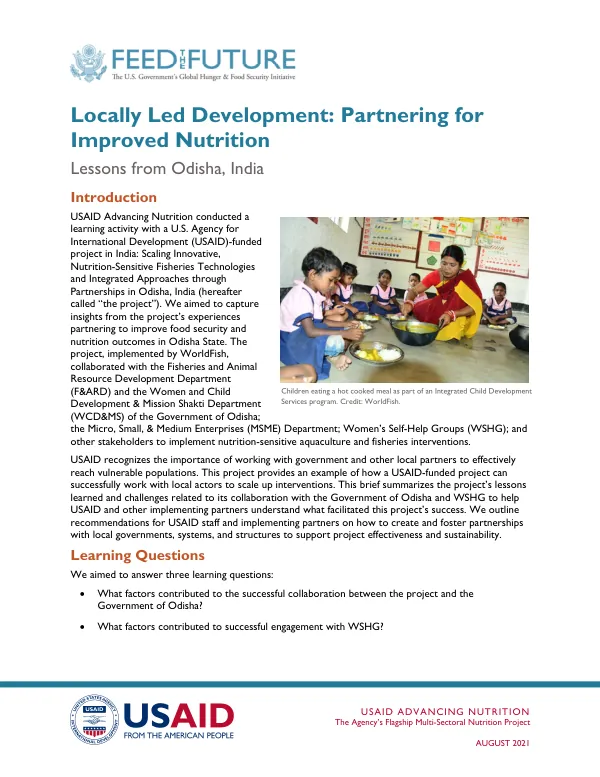
Locally Led Development: Partnering for Improved Nutrition Lessons from Odisha, India The USAID Advancing Nutrition conducted a learning activity with a U.S.
2021 · 14 pages
Sign in to readA free account is required to download.
Abstract
Agency for International Development (USAID)-funded project in India: Scaling Innovative, Nutrition-Sensitive Fisheries Technologies and Integrated Approaches through Partnerships in Odisha, India. The project, implemented by WorldFish, collaborated with the Fisheries and Animal Resource Development Department (F&ARD) and the Women and Child Development & Mission Shakti Department (WCD&MS) of the Government of Odisha; the Micro, Small, & Medium Enterprises (MSME) Department; Women's Self-Help Groups (WSHG); and other stakeholders to implement nutrition-sensitive aquaculture and fisheries interventions. The project's primary goal was to improve food and nutrition security in the Indian state of Odisha through increasing availability, accessibility, and consumption of fish and fish products. WorldFish had previously signed a memorandum of agreement (MOA) with the F&ARD to provide support in implementing the Odisha Fisheries Policy, 2015, over a period of six years. F&ARD awarded WorldFish $3.2 million for the collaborative project. The project's initial activities included piloting several nutrition-sensitive production technologies to increase the availability, accessibility, and consumption of nutrient-rich fish and vegetables. WorldFish collaborated closely with F&ARD, WCD&MS, and several other private and public organizations to introduce carp-mola polyculture, coupled with vegetable and orange-fleshed sweet potato production, to improve availability of these foods. This involved training and organizing individual farmers as well as WSHG to apply these techniques in homestead and community-leased ponds. The project also partnered with private-sector actors and ICAR-CIFT to develop and market fish-based products and collaborated with WSHG to process fish using polyhouse solar dryers. These activities started in six coastal districts of Odisha. Recognizing the potential of fish-based products to contribute to the nutritional quality of diets of pregnant women, lactating mothers, adolescent girls, and children, the project implemented an awareness campaign to promote consumption of these products during the first 1,000 days. The project partnered with a broad array of government, private sector, and research organizations to implement activities. From the outset, the project aimed to not only implement, but also scale up nutrition-sensitive fisheries technologies. Partnering with the government and WSHG was critical to the project's strategic approach. With their broad resources and networks, these partners enabled the project to better reach vulnerable populations and scale up project activities to all 30 districts of the state. Several factors facilitated collaboration between WorldFish and the government, including leveraging existing institutional relationships. WorldFish had a longstanding, strong relationship with the Government of Odisha, which was established through a previous MOA with F&ARD. This existing relationship enabled WorldFish to bid for the USAID project and facilitated the project's success. The project also partnered with other departments that are part of the Government of Odisha, including the WCD&MS and MSME. The WCD&MS in turn sponsors and manages the WSHG. The project's partnerships with the government and WSHG were critical to its success, enabling it to better reach vulnerable populations and scale up project activities. The project's collaboration with the government and WSHG also involved several other activities, including implementing innovative nutrition-sensitive aquaculture production technologies, quality dried-fish production using polyhouse solar fish dryers by WSHG, and linkages with institutional feeding programs. These activities were implemented in collaboration with various government departments, including F&ARD, WCD&MS, and ICAR-CIFT. The project's success was also attributed to its ability to leverage existing institutional relationships and build on previous projects. The project's primary partner was the F&ARD, which implemented the project with WorldFish. The project also partnered with other departments that are part of the Government of Odisha, including the WCD&MS and MSME. The project's success highlights the importance of partnering with local governments, systems, and structures to support project effectiveness and sustainability. The project's collaboration with the government and WSHG enabled it to better reach vulnerable populations and scale up project activities to all 30 districts of the state. The project's success also highlights the importance of leveraging existing institutional relationships and building on previous projects.
Related documents