USAID DEC
Low rates of early mother-to-child HIV transmission in a routine programmatic setting in Lilongwe, Malawi
Sign inMINISTRY OF HEALTH
Low rates of early mother-to-child HIV transmission in a routine programmatic setting in Lilongwe, Malawi
The Tingathe PMTCT program in Lilongwe, Malawi, aimed to reduce mother-to-child transmission of HIV.
2012 · 1 pages
Sign in to readA free account is required to download.
Abstract
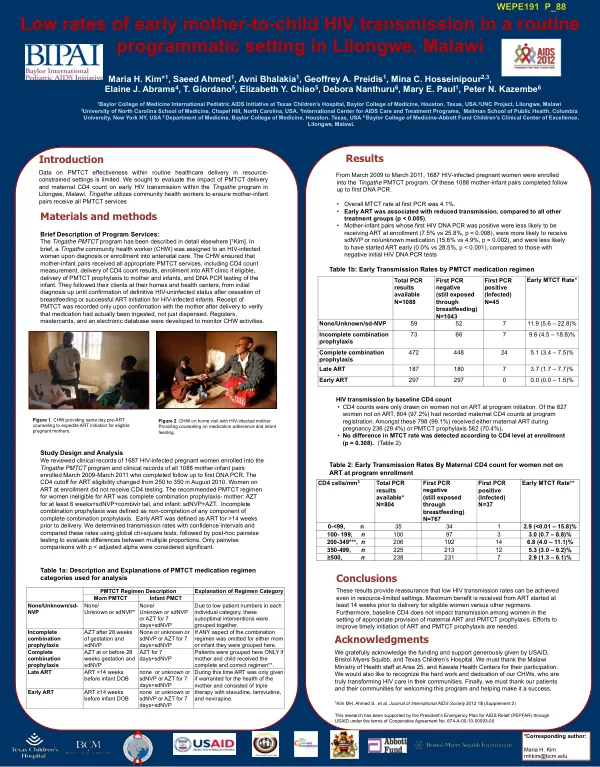
The program utilized community health workers to ensure that HIV-infected pregnant women and their infants received all necessary prevention of mother-to-child transmission (PMTCT) services. These services included CD4 count measurement, delivery of CD4 count results, enrollment into antiretroviral therapy (ART) clinic if eligible, delivery of PMTCT prophylaxis to mother and infants, and DNA PCR testing of the infant. From March 2009 to March 2011, 1687 HIV-infected pregnant women were enrolled into the Tingathe PMTCT program. Of these, 1088 mother-infant pairs completed follow-up to the first DNA PCR. The overall mother-to-child transmission (MTCT) rate at the first PCR was 4.1%. Early ART was associated with reduced transmission, compared to all other treatment groups. Mother-infant pairs whose first HIV DNA PCR was positive were less likely to be receiving ART at enrollment, more likely to receive single-dose nevirapine (sdNVP) or no/unknown medication, and less likely to have started ART early. The study found that baseline CD4 count did not impact transmission among women in the setting of appropriate provision of maternal ART and PMTCT prophylaxis. However, maximum benefit was received from ART started at least 14 weeks prior to delivery for eligible women versus other regimens. The results provide reassurance that low HIV transmission rates can be achieved even in resource-limited settings. The Tingathe PMTCT program used a regimen categorization system to analyze the effectiveness of different PMTCT regimens. The regimens were categorized as complete combination prophylaxis, incomplete combination prophylaxis, late ART, and early ART. The study found that the early ART regimen had the lowest MTCT rate, with 0.0% transmission among the 297 mother-infant pairs who received this regimen. The study also analyzed the MTCT rate by baseline CD4 count. The results showed that there was no significant difference in MTCT rate according to CD4 level at enrollment. However, the study found that the MTCT rate was lower among women who received ART at or before 28 weeks gestation and sdNVP, compared to those who received incomplete combination prophylaxis or late ART. The Tingathe PMTCT program has been supported by the President's Emergency Plan for AIDS Relief (PEPFAR) through USAID. The program has been successful in reducing MTCT rates in Lilongwe, Malawi, and has provided valuable insights into the effectiveness of different PMTCT regimens in resource-limited settings.
Related documents
Documents in this collection
 2015
2015USAID DEC
Supporting Option B+ scale up and strengthening the prevention of mother-to-child transmission cascade in central Malawi: results from a serial cross-sectional study
Open record 2021
2021USAID DEC