USAID
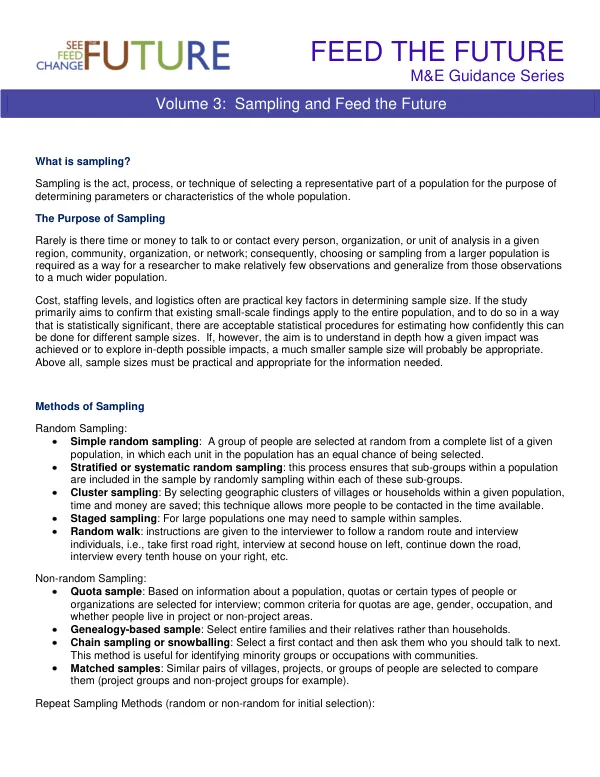
M&E Guidance Series: What is Sampling?
Sampling is the act of selecting a representative part of a population for the purpose of determining parameters or characteristics of the whole population.
3 pages
Sign in to readA free account is required to download.
Abstract
This process is necessary when it is impractical or impossible to contact every individual or unit of analysis in a given region, community, organization, or network. Sampling allows researchers to make relatively few observations and generalize from those observations to a much wider population. The purpose of sampling is to confirm that existing small-scale findings apply to the entire population, and to do so in a way that is statistically significant. However, if the aim is to understand in-depth how a given impact was achieved or to explore possible impacts, a smaller sample size may be more appropriate. Sample sizes must be practical and appropriate for the information needed. There are various methods of sampling, including random sampling and non-random sampling. Random sampling methods include simple random sampling, stratified or systematic random sampling, cluster sampling, staged sampling, and random walk. Non-random sampling methods include quota sampling, genealogy-based sampling, chain sampling or snowballing, and matched samples. Random sampling methods are often used for performance monitoring, while panel or cohort sampling is used for impact evaluations. Assessing the quality of the sample is crucial to ensure that the right type of sampling is selected and developed for its intended use. Critical questions should be addressed before and during data collection to guarantee quality sampling. Sample size depends on the nature of the analysis to be performed, the desired precision of the estimates, the kind and number of comparisons that will be made, and the number of variables that have to be examined simultaneously. In quantitative studies, representativeness is the important quality of a sample. Therefore, a key question that must be answered is whether the sample represents the key characteristics of the population being studied. Under the Feed the Future (FTF) program, sampling will be done for both performance monitoring and impact evaluation data collection. Sampling methods and sample sizes may vary between monitoring and evaluation, but samples will likely overlap between monitoring and impact evaluation for certain indicators in certain places. Every effort should be made to integrate sampling and not duplicate data collection between monitoring and impact evaluations. In each FTF focus country, multi-year strategy investments are being concentrated in selected geographic areas, referred to as the "Zone of Influence," and among a short-list of value-chains that can generate the largest poverty and nutrition impacts. The FTF goal and first-level objectives have associated indicators that require the collection of population-based individual- and household-level data at the start of the FTF investments, mid-way through implementation, and at the end of the five-year implementation period. For FTF activities, sampling will be used to generalize findings about a given group of people or organizations. For performance monitoring of higher-level standard indicators that are collected at the individual or household level, the population to be sampled is the population in the Zone of Influence. Sampling conducted in the Zone of Influence should be representative of its entire population in terms of important factors such as gender, ethnicity, class, or geographic placement.