USAID DEC
Strengthening Nursing and Midwifery Pre-Service Education in India: A National Initiative
Sign inGOVERNMENT OF INDONESIA
Strengthening Nursing and Midwifery Pre-Service Education in India: A National Initiative
The Indian Nursing Council and the Government of India launched a national initiative to strengthen nursing and midwifery pre-service education in 2009.
2013 · 4 pages
Sign in to readA free account is required to download.
Abstract
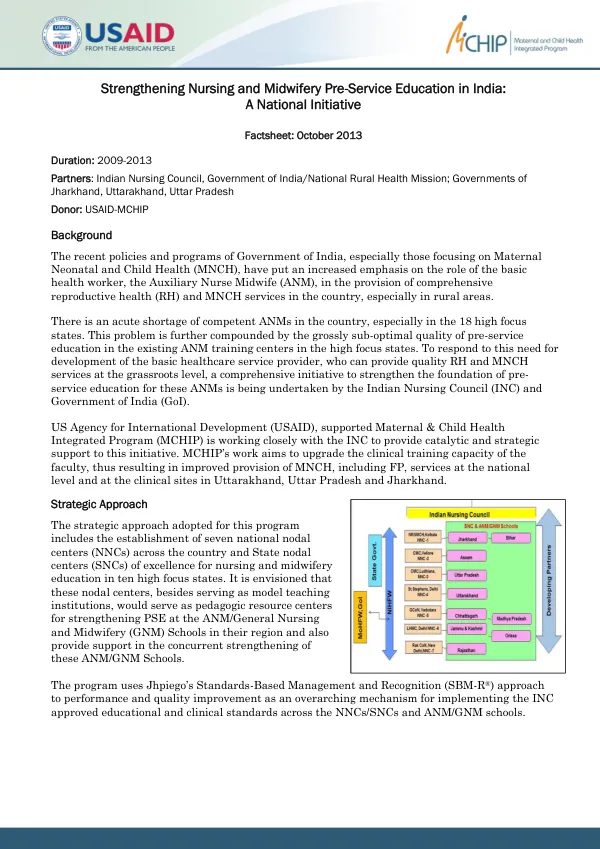
The initiative aimed to address the acute shortage of competent Auxiliary Nurse Midwives (ANMs) in rural areas, particularly in the 18 high focus states. The program was supported by the USAID-MCHIP and focused on upgrading the clinical training capacity of faculty to improve the provision of Maternal and Neonatal Health (MNCH) services. The strategic approach adopted for the program included the establishment of seven national nodal centers (NNCs) and state nodal centers (SNCs) of excellence for nursing and midwifery education in ten high focus states. These nodal centers served as model teaching institutions and pedagogic resource centers for strengthening pre-service education at the ANM/General Nursing and Midwifery (GNM) Schools in their region. The program used Jhpiego's Standards-Based Management and Recognition (SBM-R) approach to performance and quality improvement as an overarching mechanism for implementing the INC-approved educational and clinical standards. The programmatic approach focused on strengthening the national/state nodal centers and ANM/GNM Schools through the use of simple, measurable performance standards. These performance standards provided a structure for program support and a criterion-based monitoring system, allowing the INC to provide specific ongoing technical support. The major accomplishments under the project included the signing of a Memorandum of Understanding between Jhpiego and the Indian Nursing Council and state governments, the formation of a national and state-level technical advisory group, and the development of performance standards for use by NNCs, SNCs, ANM, and GNM Schools. Seven colleges of nursing were identified as national nodal centers, and the process of quality improvement was initiated at five NNCs and two SNCs with encouraging results. The NNC at Kolkata was operationalized with the setting up of a well-equipped skill lab, computer lab, and training infrastructure. Two full-time training coordinators were appointed to conduct trainings with support from the NNC faculty and mentor the ANM faculty on-site during their follow-up visits. The pre-service education performance standards included areas such as classroom and practical instruction, clinical instruction and practice, school infrastructure and training materials, school management, and clinical site practices. The fundamental principles of the program included building nursing and midwifery institutions, strengthening health systems, leveraging resources, being catalytic, and ensuring evidence-based, proven, and effective interventions. The salient features of the program included an initiative led by the Government of India and Indian Nursing Council, building on GoI's resources for training, building a quality assurance model for nursing and midwifery education in India, focusing on the basic health worker to reach the community, and focusing on clinical practices and clinical teaching in the NNCs, SNCs, ANM, and GNM Schools. At the state level, the program strengthened the pre-service education of nurses and midwives in Jharkhand and Uttarakhand. Three ANM training centers in Jharkhand and two in Uttarakhand achieved more than 80% scores on performance standards. The College of Nursing, Dehradun, was accredited by INC as a State Nodal Center, and batches of 6 weeks training for faculty of ANM/GNM schools of Uttarakhand and other high focus states were initiated later that year. The graph depicting the scores of educational standards at the NNCs and ANMTCs being strengthened under MCHIP showed that all target institutions achieved more than 80% standards on the most recent assessment. The baseline scores at these institutions ranged from less than 5% to approximately 50%. Future plans included the initiation of batches of 6 weeks training for ANM/GNM school faculty at SNCs in Jharkhand and Uttarakhand, handholding and mentorship to the NNC Kolkata to undertake independent assessment and strengthening of institutions in high focus states, introduction of uniform competency-based examination and certification for nursing-midwifery students, and continued efforts to encourage state governments to recruit more and more nursing-midwifery personnel.