FHI 360
Making Services Meaningful for Men Who Have Sex with Men
The HIV prevention, care, and treatment cascade for men who have sex with men (MSM) and other key populations is hindered by a multitude of barriers, including criminalization, stigma, and lack of access to quality health care services.
2015 · 9 pages
Sign in to readA free account is required to download.
Abstract
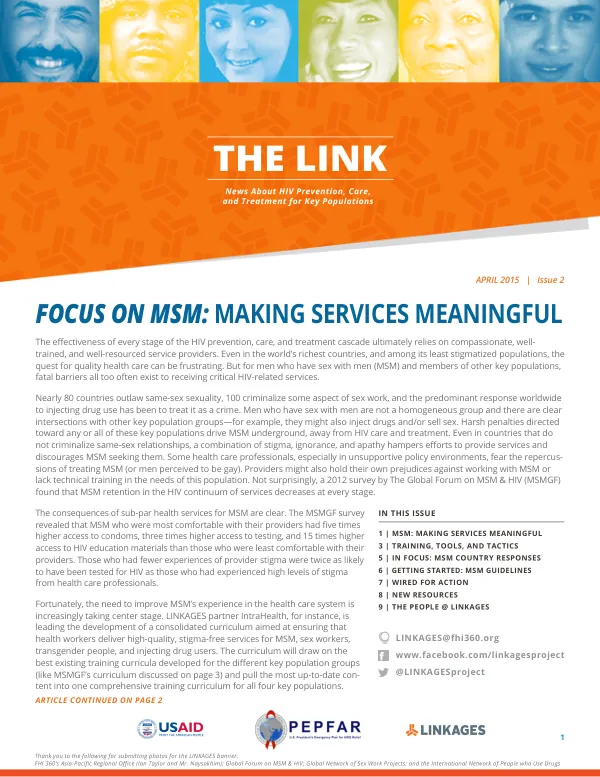
In nearly 80 countries, same-sex sexuality is outlawed, while 100 countries criminalize some aspect of sex work. Men who have sex with men are not a homogeneous group and often intersect with other key population groups, such as injecting drug users and sex workers. Harsh penalties directed toward these populations drive them underground, away from HIV care and treatment. The consequences of sub-par health services for MSM are evident. A 2012 survey by The Global Forum on MSM & HIV (MSMGF) found that MSM retention in the HIV continuum of services decreases at every stage. Those who were most comfortable with their providers had five times higher access to condoms, three times higher access to testing, and 15 times higher access to HIV education materials than those who were least comfortable with their providers. Furthermore, those who had fewer experiences of provider stigma were twice as likely to have been tested for HIV as those who had experienced high levels of stigma from health care professionals. The need to improve MSM's experience in the health care system is increasingly taking center stage. IntraHealth is leading the development of a consolidated curriculum aimed at ensuring that health workers deliver high-quality, stigma-free services for MSM, sex workers, transgender people, and injecting drug users. The curriculum will draw on the best existing training curricula developed for the different key population groups and pull the most up-to-date content into one comprehensive training curriculum for all four key populations. The rise in internet access and smartphone use around the world has created opportunities to improve MSM's access to health care services and information. Confidential, targeted, on-demand communication to and for MSM can be facilitated through these media. New research on biomedical interventions has produced exciting results that could eventually translate into practices that health care workers should embrace. The IPERGAY trial and the PROUD study have demonstrated the effectiveness of on-demand pre-exposure prophylaxis (PrEP) regimens in preventing HIV infection. The World Health Organization's recent release of the Consolidated Guidelines on HIV Prevention, Diagnosis, Treatment, and Care for Key Populations has marked an important milestone in services for key populations. Stakeholders are now drafting a practical tool for implementing these recommendations among each of the key population communities. The Men Who Have Sex with Men Implementation Tool (MSMIT) will support health care workers and implementers in developing effective programs and services for MSM. Globally, MSM-led organizations and other partners are increasingly implementing innovative, rights-based programs designed to increase uptake of testing and counseling among MSM and ensure access to and retention in care and treatment. Through South-to-South mentoring, MSM organizations can efficiently and regularly provide technical assistance to organizations in the same or neighboring countries. The meaningful engagement of MSM and other key populations in issues that affect their lives is an essential component of the approach toward managing the epidemic among key populations.