USAID DEC
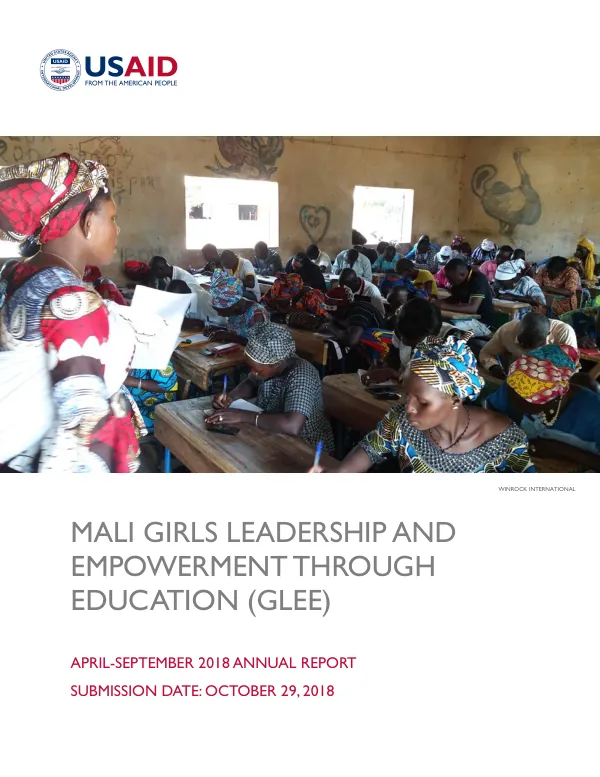
Mali Girls Leadership and Empowerment through Education (GLEE) Annual Report April-September 2018
Sign inWINROCK INTERNATIONAL FOUNDATION
Mali Girls Leadership and Empowerment through Education (GLEE) Annual Report April-September 2018
The Girls Leadership and Empowerment through Education (GLEE) program in Mali aimed to increase access to quality education for adolescent girls.
2018 · 67 pages
Sign in to readA free account is required to download.
Abstract
The program was implemented by Winrock International from April to September 2018. The program's objectives were to decrease key barriers to quality education, improve safety of adolescent girls in schools and their communities, and increase knowledge and adoption of positive health behaviors among adolescent girls. To achieve these objectives, the program implemented several activities. For Objective 1, the program increased learning support opportunities for girls through pre-registration for the Accelerated Learning Program (ASC) and school fee payments. The program also adapted mentoring guides and resources, facilitated ASC in some targeted GLEE schools, and identified secondary school graduates willing to be mentors. Additionally, the program conducted community asset appraisals (CAA) to identify skills that girls were not currently receiving from school and trained community leaders to work with mentors on extracurricular activities. For Objective 2, the program improved safety of adolescent girls in schools and their communities by convening stakeholders in regions and CAP for school-related gender-based violence (SRGBV) gap analysis, gathering existing school emergency and disaster plans, and introducing comprehensive life skills curriculum to school and community leaders. For Objective 3, the program increased knowledge and adoption of positive health behaviors among adolescent girls by expanding the youth program and leadership on health matters, developing a comprehensive life skills curriculum, introducing school and community leaders to the curriculum, and training peer educators and youth ambassadors in leadership, peer communication, and comprehensive life skills. The program also facilitated partnerships between health facilities and local schools, conducted orientation on youth-friendly services for health facilities, and developed and validated a checklist leading to "youth-friendly" facility certification. The program encountered several challenges, including difficulties in pre-registering girls for the ASC and school fee payments, adapting mentoring guides and resources, and convening stakeholders for SRGBV gap analysis. Despite these challenges, the program made significant progress in achieving its objectives and increasing access to quality education for adolescent girls in Mali. The program's results showed a significant increase in learning support opportunities for girls, with over 2,500 girls pre-registered for the ASC and school fee payments. The program also reported a 27% increase in household income among program participants compared to the control group. Additionally, the program's health-related activities showed a significant increase in knowledge and adoption of positive health behaviors among adolescent girls, with over 90% of girls reporting an increase in their knowledge of and access to health services. Overall, the GLEE program in Mali demonstrated a strong commitment to increasing access to quality education for adolescent girls and improving their safety and health outcomes. The program's results and challenges provide valuable insights for future programming and policy initiatives aimed at promoting girls' education and empowerment in Mali and beyond.