KWAME NKRUMAH UNIVERSITY OF SCIENCE AND TECHNOLOGY
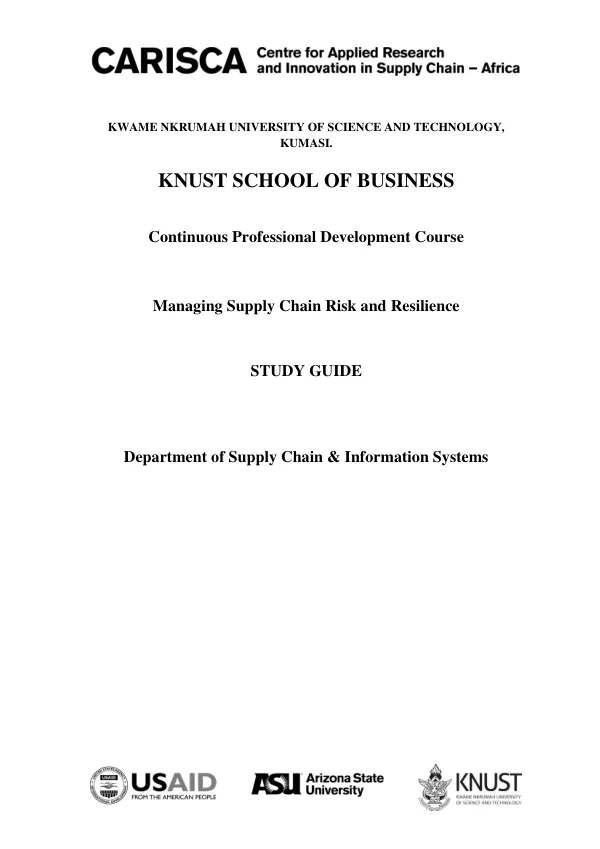
Managing Supply Chain Risk and Resilience Study Guide
Managing Supply Chain Risk and Resilience is a continuous professional development course offered by the KNUST School of Business, Department of Supply Chain & Information Systems.
14 pages
Sign in to readA free account is required to download.
Abstract
The course is designed to equip professionals and practitioners with the necessary skills to effectively manage risks and build resilience into an organization's supply chains. The course focuses on the necessary skills to identify, analyze, and apply relevant tools and methods to mitigate risks to supply chains. It covers six modules: Understanding Risks in Supply Chains, Sources of Risks in Supply Chains, Supply Chain Risk Analysis and Management Process, Supply Chain Risk Consequences, Supply Chain Risk Control Processes, and Building Supply Chain Resilience. Supply chain risk management is a continuous and developing process that runs throughout an organization's strategy and implementation. It addresses methodically all the risks surrounding the organization's activities, past, present, and future. Effective risk management should be integrated into the culture of the organization, with an effective policy and program led by senior management. The facilitator of the course, Atoapem Frimpong Barimah, is a chartered procurement and supply chain professional with over 15 years of combined professional experience. He has a background in forensic audit, supply chain enterprise systems, business process, and continuous improvement. The course covers various topics, including the risks facing organizations, operational risks in supply chains, and why supply chains are vulnerable in uncertain business environments. It also explores the sources of risks in supply chains, including supply and demand, process, environmental, network, and organizational risks. Supply chain risk management provides a system-wide approach for identifying risks, risk exposure, the severity of potential losses, and options for risk management. It involves a process of identification and registration, estimation, assessment tools, and evaluation. The course provides a framework for understanding and managing supply chain risks, enabling organizations to improve their risk management strategies and build resilience into their supply chains. The course materials include self-check multiple-choice questions, videos, and recommended readings. Participants are encouraged to engage with the online course room and share their experiences on the self-check multiple-choice question forum. The lead facilitator may provide additional information to the class where necessary. Overall, the Managing Supply Chain Risk and Resilience course is designed to equip professionals and practitioners with the necessary skills to effectively manage risks and build resilience into an organization's supply chains. It provides a comprehensive framework for understanding and managing supply chain risks, enabling organizations to improve their risk management strategies and build resilience into their supply chains.
Related documents