USAID DEC
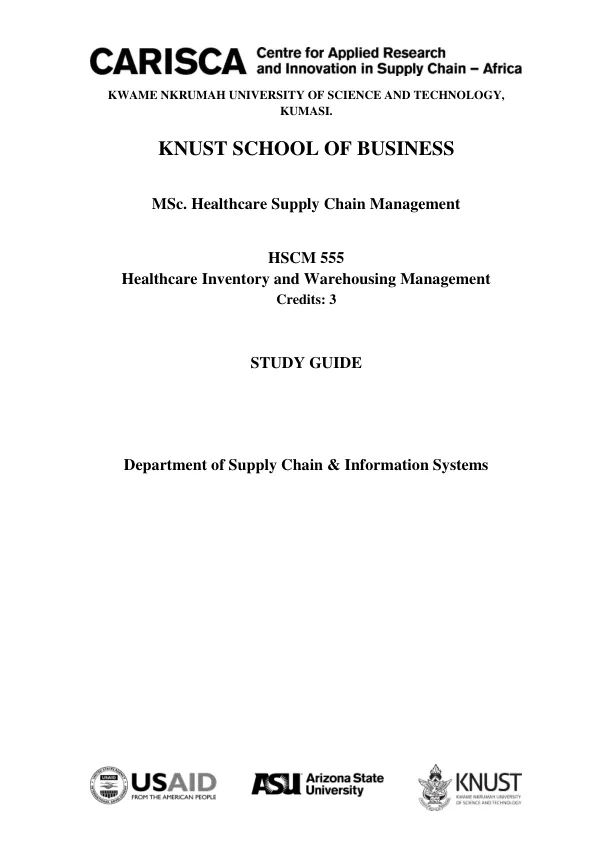
MSc. Healthcare Supply Chain Management Study Guide: HSCM 555 Healthcare Inventory and Warehousing Management
Sign inKWAME NKRUMAH UNIVERSITY OF SCIENCE AND TECHNOLOGY
MSc. Healthcare Supply Chain Management Study Guide: HSCM 555 Healthcare Inventory and Warehousing Management
The course HSCM 555 Healthcare Inventory and Warehousing Management is designed to introduce students to current issues in inventory management and related warehousing issues within the healthcare supply chain management context.
26 pages
Sign in to readA free account is required to download.
Abstract
The course is divided into six units, each containing a minimum of three sections, and focuses on providing students with relevant inventory models and techniques, as well as awareness of new technologies that can be applied to achieve successful business outcomes. Inventory control is essential for pharmacies, as it enables them to manage their stock levels effectively, reduce waste, and improve customer satisfaction. The objectives of inventory control within a pharmacy include ensuring that the right products are available at the right time, minimizing stockouts and overstocking, and optimizing inventory turnover. Inventory control involves the use of various purchasing concepts, such as just-in-time (JIT) inventory management, economic order quantity (EOQ), and vendor-managed inventory (VMI). The course covers various methods for controlling inventory, including the use of inventory management software, accurate quantification of ordering pharmaceuticals and health supplies, and the identification of appropriate records used in inventory management. Students are also expected to develop skills in generating reports on the distribution of pharmaceutical supplies and receiving and issuing procured inventory. The course requires students to have a working knowledge of some of the most common receiving and storage policies, as well as an understanding of some of the different models for inventory control. The course also covers the importance of purchasing policies and their value within the pharmacy. The course is supported by a range of textbooks and readings, including "Operations Management: Theory and Practice" by W.J. Stevenson, "Managing Supply Chains-A Logistics Approach" by J.J. Coyle, C.J. Langley, R.A. Novack, and B.J. Gibson, and "Inventory Control In Pharmaceutical Supply Chain" by Pinto Fredaric. The course grading is based on hand-ins, including one individual assignment, one group assignment, participation in group discussions, a mid-semester examination, and an end-of-term examination. The assignments are due before the end of the specified day of delivery, and failure to deliver assignments on the specified date will attract penalties in the form of a reduced grade. The course requires students to exhibit utmost academic and scientific writing skills in their presentations and assignments, and all assignments should be written in Times New Roman, Font size 12, 1.5 spaced with one-inch margins, and with a list of references based on and formatted to the Harvard Style. The course schedule includes a range of assignments, including a summary writing assignment, multiple-choice questions, self-check questions, a case study and PowerPoint presentation, and a summary writing assignment. The assignments are due at various times throughout the course, and students are expected to participate in online discussions, which will account for 5% of the final grade. The course covers a range of topics, including inventory control and planning, inventory management practices at Walmart, and the importance of purchasing policies and their value within the pharmacy. The course requires students to have a working knowledge of some of the most common receiving and storage policies, as well as an understanding of some of the different models for inventory control. The course is designed to provide students with the skills and knowledge necessary to manage inventory effectively in a healthcare supply chain management context. The course covers a range of topics, including inventory control and planning, inventory management practices at Walmart, and the importance of purchasing policies and their value within the pharmacy.