ABT ASSOCIATES
Mangla Refurbishment Project M&E Site Visit Report
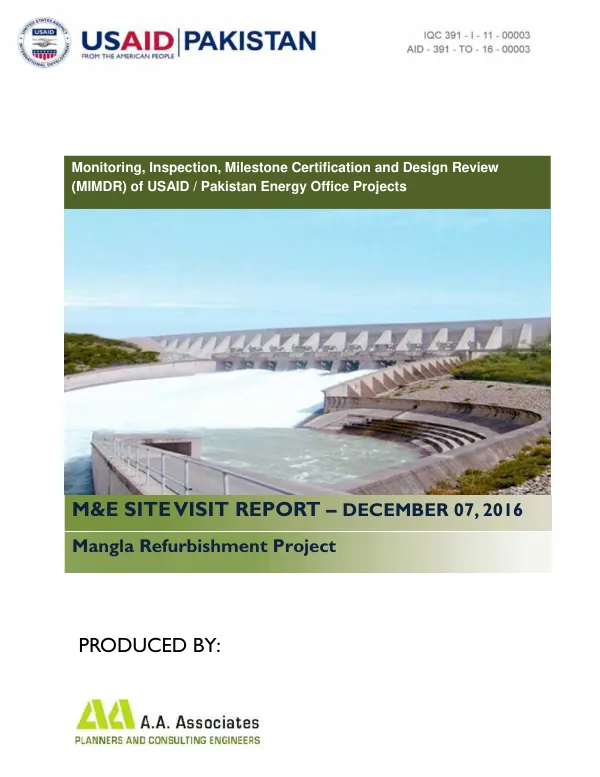
The Mangla Refurbishment Project is a USAID-funded initiative aimed at improving the power generation capacity of the Mangla Dam in Pakistan.
2016 · 26 pages
Sign in to readA free account is required to download.
Abstract
The project is part of the USAID/Pakistan Energy Office Projects, and its primary objective is to increase the power generation capacity of the Mangla Dam by refurbishing and upgrading its units. The project commenced in 2016, with the first phase focusing on improving system reliability and limiting breakdowns. However, the project officials acknowledged that no significant progress has been made in terms of MW or units of electricity generated since the project's commencement. The baseline for the MSF indicators relevant to the Mangla Refurbishment Project would be "zero" due to the lack of progress. The project officials discussed the target setting for the FY2017 to FY2019, with nearly all activities under Phase-2 aimed at improving system reliability and limiting breakdowns. However, Activity No. 1, "Refurbishment and Up-Gradation of units 5&6," is expected to contribute to an additional capacity of 90 MW to the power station. The completion of this task is anticipated in December 2018, and the intended benefits would start realizing thereafter. The project officials also discussed the periodic progress reporting, with the project office preparing monthly progress reports that encompass details about the physical and financial progress achieved by the project in a specific month. The copies of the monthly report are circulated to USAID and WAPDA higher-ups. The project plan/schedule was also discussed, with the project director suggesting that the M&E team write an email to request the project plan. However, the project director referred to the Attachment-3 (Payment Milestone Schedule) of the Mangla Phase-1 PIL, which signifies the target dates of project milestones. The M&E team highlighted that some of the dates mentioned against the milestones had been passed, but the milestone was yet to be achieved. The project officials acknowledged the importance of developing an M&E plan to implement a monitoring and evaluation function within the project, consistent with the USAID requirements for G2G project Grantees. However, it was observed that the M&E plan has not been prepared as of now. The M&E team conducted a site visit to the Mangla Dam and Power Station on December 07, 2016, to discuss the M&E system with the project officials. The team discussed the M&E plan, performance indicators, mechanism of data collection, and reporting system against the performance indicators, activity plan/schedule, and collected supporting documents such as copies of project progress reports and log sheets pertaining to MW and units of electricity. The M&E team also requested the project director to nominate a focal person who could facilitate the M&E team not only during the visit but in the future for coordination of M&E activities and data collection. In response, Mr. Tassawar Kamal, Project Engineer MRP, was nominated by the project director as a focal person for M&E-related activities. The M&E team observed that the Attachment which usually talks about the USAID M&E regulations for Grantees is not included in the PIL document. However, based on the understanding that the M&E is a crucial function for a USAID-funded project, it was assumed that Mangla should also need to develop an M&E plan to implement a monitoring and evaluation function within the project, consistent with the USAID requirements for G2G project Grantees.
Related documents
Documents in this collection
 2019
2019USAID DEC
RESETTLEMENT ACTION PLAN - MONITORING REPORT KAITU WEIR AND AFFILIATED POWER AND IRRIGATION ELEMENTS (STAGE 1 OF KURRAM TANGI DAM PROJECT)
Open record 2016
2016USAID DEC