JHPIEGO
Maternal and Child Survival Program (MCSP)
Nutrition plays a critical role in child and maternal health, with undernutrition being a leading cause of child deaths worldwide.
2015 · 2 pages
Sign in to readA free account is required to download.
Abstract
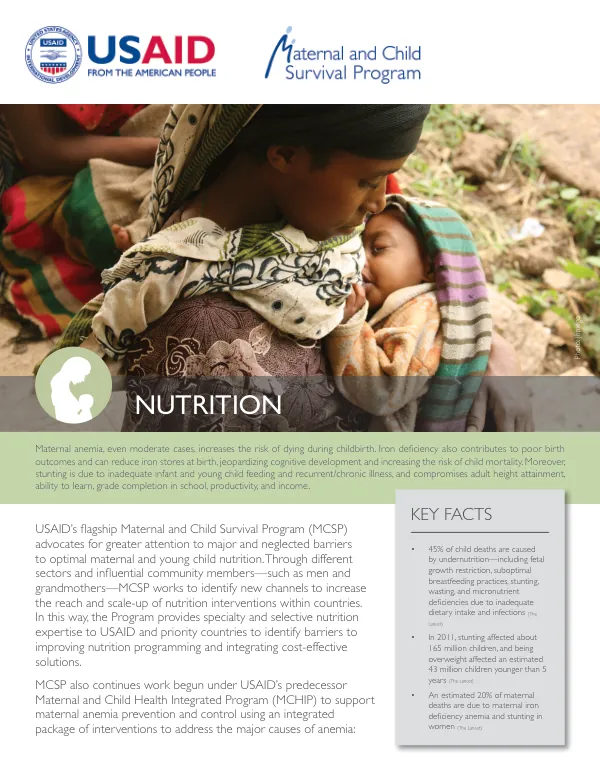
According to The Lancet, 45% of child deaths are attributed to undernutrition, including fetal growth restriction, suboptimal breastfeeding practices, stunting, wasting, and micronutrient deficiencies due to inadequate dietary intake and infections. In 2011, stunting affected approximately 165 million children, while being overweight affected an estimated 43 million children younger than 5 years. Maternal anemia, particularly iron deficiency anemia, is a significant concern, accounting for an estimated 20% of maternal deaths. Moderate cases of maternal anemia increase the risk of dying during childbirth, while iron deficiency also contributes to poor birth outcomes and can reduce iron stores at birth, jeopardizing cognitive development and increasing the risk of child mortality. Stunting, resulting from inadequate infant and young child feeding and recurrent/chronic illness, compromises adult height attainment, ability to learn, grade completion in school, productivity, and income. The Maternal and Child Survival Program (MCSP), a USAID Cooperative Agreement, advocates for greater attention to major and neglected barriers to optimal maternal and young child nutrition. Through various sectors and influential community members, including men and grandmothers, MCSP works to identify new channels to increase the reach and scale-up of nutrition interventions within countries. The Program provides specialty and selective nutrition expertise to USAID and priority countries to identify barriers to improving nutrition programming and integrating cost-effective solutions. MCSP continues the work of its predecessor, the Maternal and Child Health Integrated Program (MCHIP), to support maternal anemia prevention and control using an integrated package of interventions to address the major causes of anemia, including nutritional deficiencies and parasitic infections due to malaria and soil-transmitted helminth infections. The Program also supports global learning on community-based distribution of iron-folic acid, identifying unaddressed breastfeeding problems leading to early introduction of food, assessing the problem of "junk food" consumption in developing countries, and improving dietary intake during pregnancy. Taking a "learning by doing" approach, MCSP integrates lessons learned from countries where the Program is integrating nutrition, and monitors the change in the uptake of key nutrition practices to further improve program implementation. The Program's focus on nutrition is part of its broader goal of ensuring that all women, newborns, and children most in need have equitable access to quality health care services to save lives.