JHPIEGO
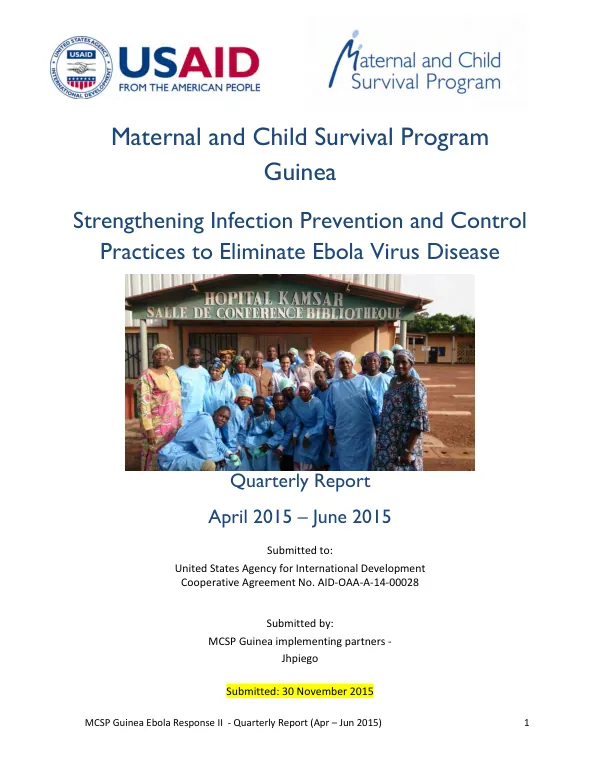
Maternal and Child Survival Program Quarterly Report: January 2015 – March 2015
The Maternal and Child Survival Program in Guinea aims to contribute to improved maternal and child health and reductions in preventable deaths through continued support to the Ministry of Health to improve the quality and availability of Reproductive, Maternal, Newborn and Child Health (RMNCH) Services.
2015 · 24 pages
Sign in to readA free account is required to download.
Abstract
The program is implemented in partnership with Jhpiego and focuses on three main objectives. Objective 1 seeks to improve and sustain the quality of RMNCH services in supported health care facilities within the project's targeted area. Key activities under this objective include supporting 34 healthcare facilities implementing Standards-based Management and Recognition (SBM-R) to continue use of this process to monitor and improve the quality of care. Twenty-four providers completed training on Module 3 at 5 SBM-R sites in the Faranah region, thus completing the introduction of this quality improvement process. MCSP monitored the implementation of performance standards in maternal health care at eight health facilities in the Faranah and N'zérékoré regions, focusing specifically on Emergency Obstetric and Neonatal Care (EmONC), obstetric surgery, and anesthesia competencies. Objective 2 aims to improve the quality of pre-service midwifery education at the National Public Health School in Kindia (ENSK) and the medical education at the Faculty of Medicine in Conakry. Key activities under this objective include reinforcing the quality of pre-service education for midwives. Conducted support visits were made to monitor RH training updates of teachers and trainers at 3 health schools and 7 internship sites. An orientation on the new family health curriculum was completed targeting the staff and supervisors of ENSK. Meetings were facilitated with MEET-PF and ENSK to discuss the April 2015 dissemination of the updated midwifery curriculum via a series of workshops with managers and directors from the major health schools. Objective 3 seeks to integrate activities and services for the prevention and management of Gender-Based Violence (GBV) within RMNCH services at the facility and community levels in Conakry. Key activities under this objective include integrating Information, Education, and Communication (IEC) activities related to prevention and care seeking related to GBV into community level interventions. Community orientation meetings were completed with 418 participants, which focused on introducing the project, the expected roles and responsibilities of community educators within the framework of GBV, and community involvement. Individual interviews were completed with 58 potential community educators. Selection criteria for GBV educators were defined, and a list of targeted schools and universities was drafted in a meeting with representatives from MCSP, the National Directorate of Professional Training of the Ministry of Technical and Vocational Education, the municipal Directorate of Education (DCE) of the Department of Pre-University Education; and the Secretary General of Gamal University of Conakry and his staff. The program has made significant progress in the second quarter of 2015, with notable achievements in the areas of quality improvement, pre-service education, and GBV prevention and management. The program continues to work closely with the Ministry of Health and other stakeholders to ensure the sustainability of these efforts and to achieve the program's overall goal of reducing preventable maternal and child deaths in Guinea.