JHPIEGO
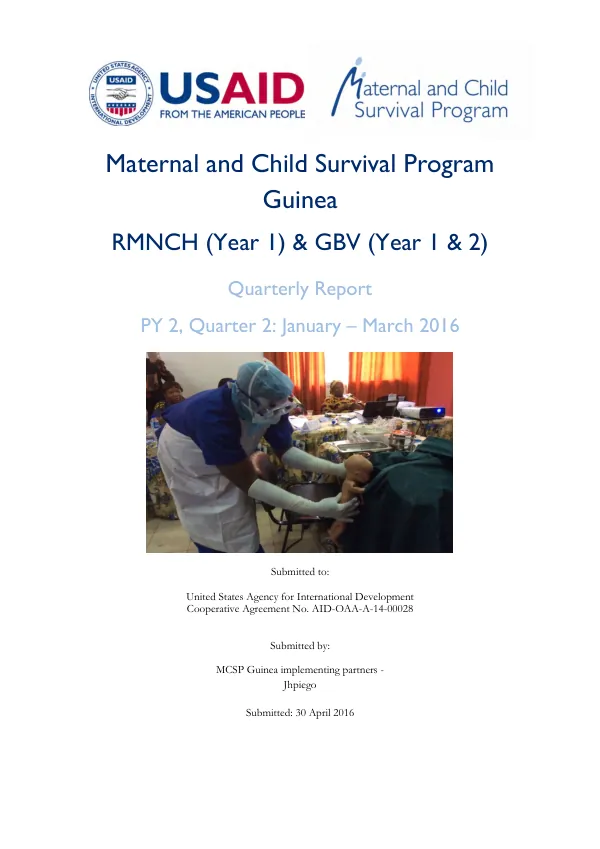
MCSP Guinea RMNCH/GBV FY16 Quarter 2 Report (January-March 2016)
The Maternal and Child Survival Program in Guinea is a global cooperative agreement aimed at introducing and supporting high-impact health interventions to end preventable maternal and child deaths.
2016 · 31 pages
Sign in to readA free account is required to download.
Abstract
The program's goal is to contribute to improved maternal and child health and reductions in preventable deaths through continued support to the Ministry of Health to improve the quality and availability of Reproductive, Maternal, Newborn and Child Health (RMNCH) Services. During the second quarter of Year 2, significant accomplishments were achieved in the project's objectives. Objective 1 aimed to improve and sustain the quality of RMNCH services in supported health care facilities within the project's targeted area. The Ministry of Health developed and initiated a monitoring plan for the implementation of the Standards-based Management and Recognition (SBM-R) system, which was forwarded to the Regional Directors of Health for integration into the 2015-2017 regional and prefectural health development plans. The SBM-R approach was implemented in 48 health facilities, resulting in notable achievements in maternal and newborn health. Ninety-eight percent of recorded cases of pre-eclampsia and eclampsia were treated with magnesium sulfate, and 95% of women received active management of the third stage of labor. Additionally, 87% of newborns were put to the breast within the first hour after delivery. A total of 2,297 cases of complications were treated. MCSP conducted on-site supervisory MNCH visits to 8 health facilities in Siguiri Prefecture, observing 12 trained providers providing Jadelle implant services, with 7 out of 12 (58%) receiving high performance scores. A total of 44 clients benefited from these services during the quarter. For IUD services, 13 providers trained were observed providing IUD services, with 11 providers (85%) receiving high performance scores. In total, 11 clients received an interval IUD and 23 clients received a PPIUD. The provision of Family Planning (FP) services at different service delivery points achieved significant results during the quarter. A total of 40,450 new FP users were recorded, including 8,889 at the community level. Regular FP users totaled 32,548, including 8,914 at the community level. One hundred percent of women given postabortion care also received PPFP counseling, and 86% of them accepted a family planning method. This quarter's results translate into 27,066 years of coupled protection, of which 56% are comprised of long-acting methods. MCSP, in collaboration with APIC, conducted supervisory visits in Dinguiraye and Dabola prefectures that reached 52 community health workers from 38 villages. Of the CHWs supervised, 29 (or 56%) received high or good performance scores. Objective 2 aimed to improve the quality of pre-service midwifery education at the National Public Health School in Kindia (ENSK) and the medical education at the School of Medicine in Conakry. However, no activities were conducted for this objective during the quarter, as the RMNCH scope and funding came to an end. Objective 3 focused on integrating activities and services for the prevention and management of Gender-Based Violence (GBV) within RMNCH services at the facility and community levels in Conakry. MCSP supported the GBV steering committee's establishment of communal committees in partnership with the Directeur des Micro Réalisations (DMR) of Conakry's five municipalities. The launch of the GBV project was attended by nearly 600 people, including representatives from women's, youth, religious, and local organizations. Under the legal assistance program component, led by the American Bar Association, 10 paralegals started working in five districts of Conakry to provide mediation, legal education, and awareness raising, targeting populations at risk for facing sexual and gender-based violence. Seventeen cases were brought to the legal aid clinic operated by the local civil society partner, Les Mêmes Droits Pour Tous (MDT). The paralegals conducted 58 awareness raising, education, and outreach sessions that reached 3,200 women and girls as of March 31, 2016. MDT's paralegals also held 72 separate sessions for local authorities, including police, gendarmes, and governmental actors. The Maternal and Child Survival Program engages governments, policy makers, private sector leaders, health care providers, civil society, religious organizations, and communities in the adoption and acceleration of proven approaches to improve maternal and child health. The program's activities are aimed at reducing preventable maternal and child deaths in a generation.
Related documents