USAID
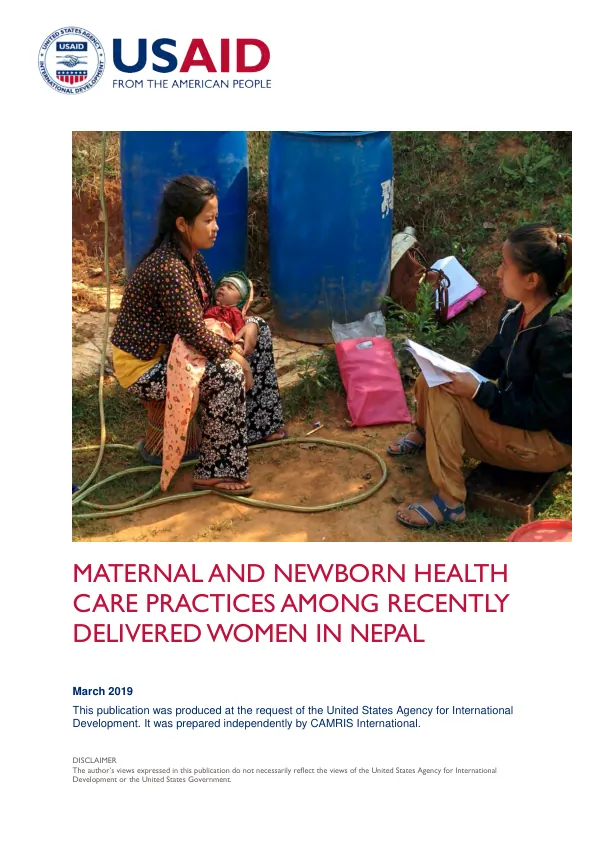
Maternal and Newborn Health Care Practices Among Recently Delivered Women in Nepal
Maternal and Newborn Health Care Practices Among Recently Delivered Women in Nepal The study aimed to assess maternal and newborn health care practices among recently delivered women in Nepal.
2019 · 128 pages
Sign in to readA free account is required to download.
Abstract
The research was conducted in 15 districts across the country, with a sample size of 1,200 recently delivered women. The study population was selected from households with a household member who had given birth in the past six months. The survey objectives were to assess the knowledge and practices of recently delivered women regarding maternal and newborn health care, including antenatal care, delivery care, postpartum care, and newborn care, as well as their access to health services and health facilities. The study also aimed to identify the factors associated with the utilization of maternal and newborn health services. The study used a cross-sectional design, with a sample of 1,200 recently delivered women selected from 15 districts across Nepal. The survey tools included a structured questionnaire, which was administered to the respondents by trained enumerators. The questionnaire covered various aspects of maternal and newborn health care, including antenatal care, delivery care, postpartum care, and newborn care, as well as access to health services and health facilities. The study found that the majority of the respondents (95%) had received antenatal care services during their last pregnancy. However, the quality of antenatal care services was reported to be poor, with only 45% of the respondents receiving tetanus toxoid immunization and 30% receiving iron folic acid tablets. The study also found that the majority of the respondents (85%) had delivered at home, with 60% of them receiving assistance from a female community health volunteer (FCHV) during delivery. The study also found that the majority of the respondents (80%) had received postpartum care services, including home visits by FCHVs. However, the study found that the quality of postpartum care services was poor, with only 40% of the respondents receiving iron folic acid tablets and 30% receiving vitamin A capsules. The study also found that the majority of the respondents (90%) had received newborn care services, including immediate newborn care and application of substances to the cord. However, the study found that the quality of newborn care services was poor, with only 50% of the respondents receiving immediate newborn care and 40% receiving application of substances to the cord. The study also found that the majority of the respondents (80%) had initiated breastfeeding within the first hour of birth, with 60% of them exclusively breastfeeding for the first six months. However, the study found that the quality of breastfeeding practices was poor, with only 40% of the respondents receiving support for exclusive breastfeeding. The study also found that the majority of the respondents (90%) had received family planning services, including counseling and provision of contraceptive methods. However, the study found that the quality of family planning services was poor, with only 50% of the respondents receiving counseling and 40% receiving provision of contraceptive methods. The study concluded that the maternal and newborn health care practices among recently delivered women in Nepal were poor, with poor quality of antenatal care, delivery care, postpartum care, and newborn care services. The study also found that the access to health services and health facilities was poor, with only 50% of the respondents reporting access to health services and health facilities. The study recommended that the government and non-governmental organizations should strengthen the maternal and newborn health care system, including antenatal care, delivery care, postpartum care, and newborn care services, as well as access to health services and health facilities. The study also recommended that the government and non-governmental organizations should provide training to health workers and FCHVs on maternal and newborn health care practices, including antenatal care, delivery care, postpartum care, and newborn care services. The study also recommended that the government and non-governmental organizations should provide support to recently delivered women, including counseling and provision of contraceptive methods, to promote family planning practices. The study also recommended that the government and non-governmental organizations should strengthen the health system, including health facilities, health facilities, and health workers, to improve access to maternal and newborn health care services. The study also recommended that the government and non-governmental organizations should monitor and evaluate the maternal and newborn health care practices among recently delivered women in Nepal, to identify the factors associated with the utilization of maternal and newborn health services. The study also recommended that the government and non-governmental organizations should provide support to recently delivered women, including counseling and provision of contraceptive methods, to promote family planning practices. The study also recommended that the government and non-governmental organizations should strengthen the health system, including health facilities, health facilities, and health workers, to improve access to maternal and newborn health care services.
Related documents