INTERNATIONAL PEACE CORPS
Maternal and Newborn Health: Engaging Influential Actors
The continuum of care model for Maternal and Newborn Health recognizes the influence of households, communities, and outreach and facilities on maternal and newborn health outcomes.
2014 · 22 pages
Sign in to readA free account is required to download.
Abstract
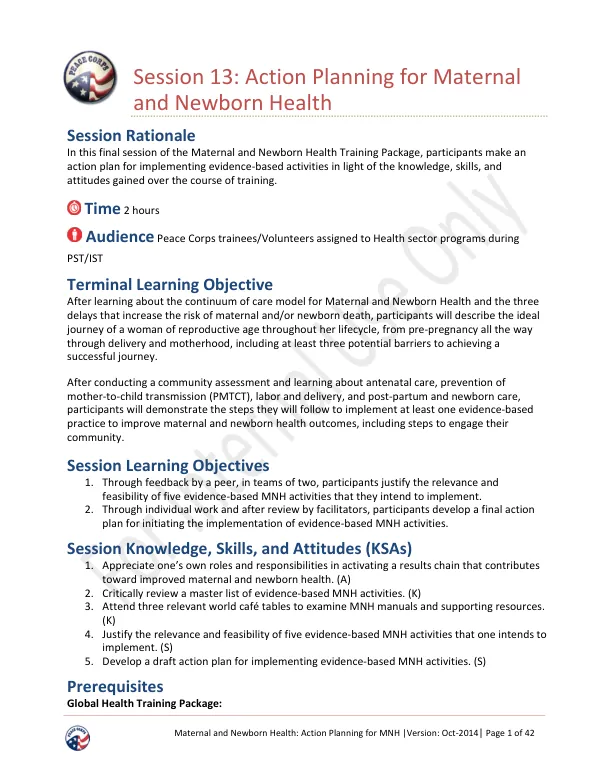
This model visualizes the journey of a woman of reproductive age throughout her lifecycle, from pre-pregnancy to delivery and motherhood. The three delays that increase the risk of maternal and/or newborn death are identified as the delay in seeking care, the delay in reaching a health facility, and the delay in receiving adequate care at the facility. The Peace Corps trainees assigned to health programs during PST or IST are trained to understand the importance of engaging influential actors and groups for social and behavior change related to maternal and newborn health. The trainees learn to appreciate the role of culture and social influence in shaping women's practices and behaviors. They are also trained to use a tool called the orbits of influence to identify actors at household, community, and health facility levels who influence specific MNH behaviors. The trainees practice using the orbits of influence tool through small group work and interviews with key informants. They analyze and name three ways that evidence-based approaches and activities to engage influential actors in MNH consider culture and social influence. They also list at least two ways that evidence-based approaches and activities to engage influential actors in MNH can be applied to Volunteer activities. The trainees are expected to demonstrate the steps they will follow to implement at least one evidence-based practice to improve maternal and newborn health outcomes, including steps to engage their communities. They are also expected to describe the ideal journey of a woman of reproductive age throughout her lifecycle, from pre-pregnancy to delivery and motherhood, including at least three potential barriers to achieving a successful journey. The training package includes a session outline, trainer expertise, and materials required for the session. The trainer is expected to review the entire session plan, handouts, and PowerPoint presentation, and plan the session according to the time available. The trainer is also expected to organize participant seating in small groups, write session learning objectives on a sheet of flip chart paper, and tape the continuum of care framework wall chart to the wall. The training materials include a social influence analysis tool, handouts on involving grandmothers and influential community actors for adolescent health and development, and men's engagement in family planning. The trainer is expected to prepare trainer materials, including a PowerPoint presentation, desired behaviors, and a small group task. The training is designed to equip Peace Corps trainees with the knowledge, skills, and attitudes required to engage influential actors and groups for social and behavior change related to maternal and newborn health.
Related documents