JHPIEGO
MCSP Nigeria - Maternal Health Technical Brief
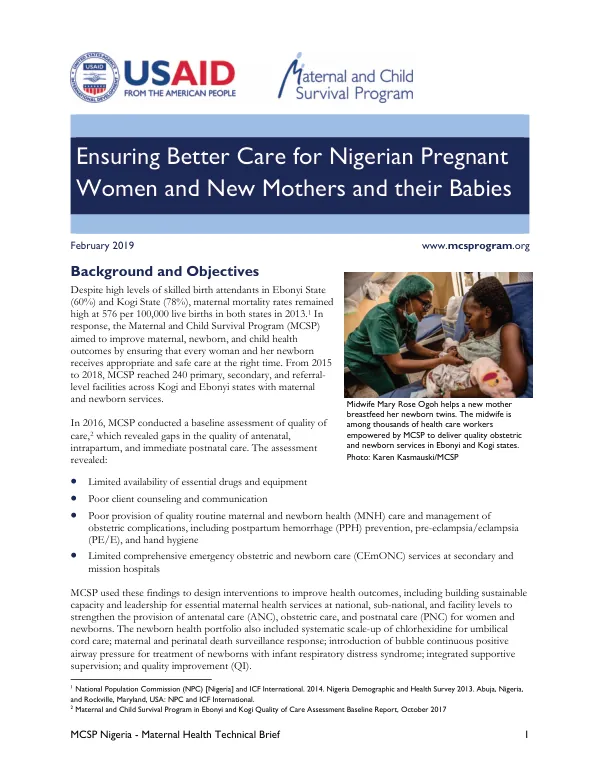
The Maternal and Child Survival Program (MCSP) in Nigeria aimed to improve maternal, newborn, and child health outcomes in Ebonyi and Kogi states.
2019 · 8 pages
Sign in to readA free account is required to download.
Abstract
Despite high levels of skilled birth attendants in both states, maternal mortality rates remained high at 576 per 100,000 live births in 2013. MCSP reached 240 primary, secondary, and referral-level facilities across the two states with maternal and newborn services from 2015 to 2018. A baseline assessment of quality of care conducted in 2016 revealed gaps in the quality of antenatal, intrapartum, and immediate postnatal care. The assessment identified limited availability of essential drugs and equipment, poor client counseling and communication, and poor provision of quality routine maternal and newborn health care and management of obstetric complications. MCSP used these findings to design interventions to improve health outcomes, including building sustainable capacity and leadership for essential maternal health services. MCSP focused on increasing the competence of health workers through training, updating national policies, and strengthening institutions. The program ensured facility readiness by improving referral systems and the availability of essential equipment, commodities, and supplies. MCSP also helped communities provide assistance to women through emergency transport and loans for emergency health expenses. Capacity building was a key component of MCSP's approach, with a focus on basic and comprehensive emergency obstetric and newborn care. MCSP trained over 1,500 health care workers from 240 public and private health facilities on basic emergency obstetric and newborn care and service delivery. The program also introduced quality of care teams and quality improvement processes and data measures to 91 facilities in Ebonyi and Kogi states. Implementation of Nigeria's maternal and perinatal death surveillance and response (MPDSR) system was another key component of MCSP's approach. The program strengthened the implementation of the MPDSR system and worked to align MPDSR efforts with ongoing quality improvement processes and committee structures. MCSP sensitized and oriented key stakeholders, supported the establishment of MPDSR committees, and provided training and ongoing support to MPDSR committees. Referral systems and emergency transportation for women and newborns with complications were also improved through MCSP's support. The program collaborated with state ministries of health, local government areas, and the National Union of Road Transport Workers to introduce an emergency transport scheme, which mobilized volunteer drivers to provide transportation to health centers and hospitals. Over 110 drivers volunteered for the scheme and were trained in emergency first aid and handling children and pregnant women. Mothers' savings and loan clubs were also established in selected communities to address the lack of funds for transport to health facilities. Over 2,095 women joined more than 60 clubs, which were led by MCSP-trained community facilitators and promoted financial empowerment through small business loans and funds to pay for emergency health expenses. The clubs collected 5 million Naira and disbursed interest-free loans for medical emergencies to club members.