HELLEN KELLER INTERNATIONAL
MC Niger Sawki Quarterly Report FY 16 Q3
The agricultural development initiative in Niger began in 2012 as a five-year program funded by the United States Agency for International Development (USAID)/Food for Peace (FFP).
2016 · 24 pages
Sign in to readA free account is required to download.
Abstract
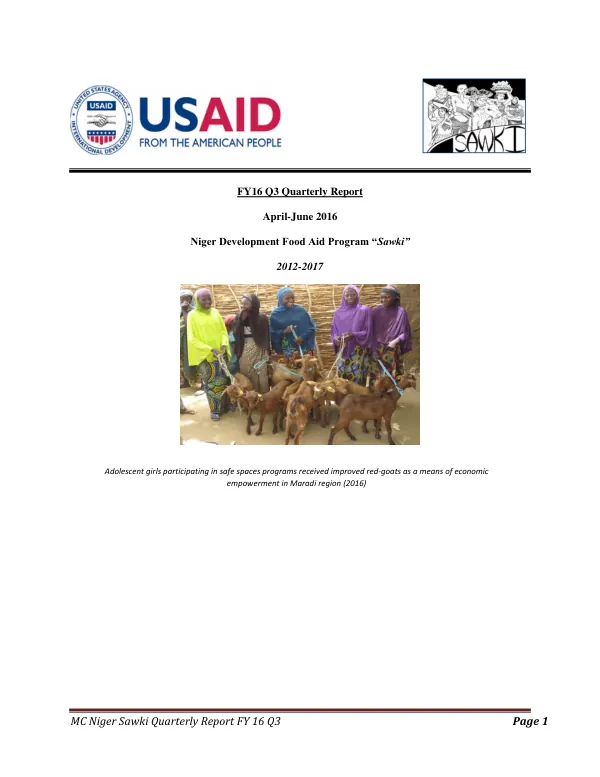
The program, known as Sawki, aimed to reduce food insecurity and malnutrition in Maradi and Zinder regions, two of the most food insecure regions in Niger. The program targeted 62 villages based on social vulnerability, economic, and agro-pastoral linkages. The program's two strategic objectives were to reduce malnutrition among pregnant and lactating women and children under two, and to increase local availability of and access to nutritious food by diversifying agricultural production and rural households' income. The program implemented various activities under these objectives, including training midwives and health workers on Integrated Management of Childhood Illnesses (IMCI) services, promoting appropriate nutrition practices during a child's first 1,000 days, and conducting cooking demonstrations to promote the consumption of locally available nutrient-rich foods and animal products. Under the first strategic objective, the program trained 34 midwives and health workers on IMCI services, and held monthly sessions to sensitize lead mothers, health promoters, and mentors on family planning practices. The program also conducted child growth monitoring, which showed that out of 13,758 children screened, 790 children were classified as moderately malnourished, while 256 children were classified as severely malnourished and were referred to health centers for investigation and monitoring. Under the second strategic objective, the program prioritized conservation and dissemination of orange-fleshed sweet potatoes, trained 237 producers on vegetable gardening techniques, and set up 68 new Farmer Field Schools. The program also provided technical assistance to livestock farmers, including animal health workers provided services to 713 livestock farmers and treated 787 cattle, 1,408 sheep, and 2,517 goats under the guidance of private veterinary officers at the department level. The program also implemented cross-cutting gender activities, including providing vocational skills training for 3,100 adolescent girls, working with 1,080 adolescents in literacy centers, and providing counseling and guidance to adolescent girls in safe spaces. The program continued to build relationships between consortium partners, including the Program Management Unit (PMU) based in Maradi and Zinder, and participating in coordination meetings with partners representing the Ministries of Agriculture, Public Health, and Planning and INRAN. The program's progress towards achieving its objectives was significant, with the program continuing to implement various activities under its two strategic objectives. The program's focus on reducing malnutrition and increasing access to nutritious food was evident in its activities, including training midwives and health workers on IMCI services, promoting appropriate nutrition practices, and conducting cooking demonstrations. The program's commitment to gender equality was also evident in its activities, including providing vocational skills training for adolescent girls and working with adolescents in literacy centers. The program's achievements in the reporting quarter were notable, with the program training 34 midwives and health workers on IMCI services, holding monthly sessions to sensitize lead mothers, health promoters, and mentors on family planning practices, and conducting child growth monitoring. The program also prioritized conservation and dissemination of orange-fleshed sweet potatoes, trained 237 producers on vegetable gardening techniques, and set up 68 new Farmer Field Schools.