USAID
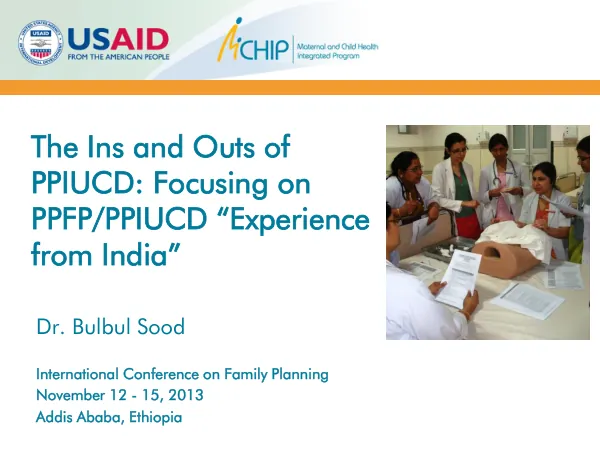
MCHIP-PSE: PPIUCD Experience from India
The Government of India (GOI) has made a renewed effort to focus on spacing by revitalizing the use of Intrauterine Contraceptive Devices (IUCDs), including Post-Placental IUCD (PPIUCD) and Interval IUCD.
2013 · 9 pages
Sign in to readA free account is required to download.
Abstract
This effort is part of the country's broader strategy to improve family planning services. The Maternal and Child Health Integrated Program (MCHIP) provided technical assistance to support both the demand and supply sides of the equation, including the development of training, counseling, and service support materials for the scale-up of Post-Placental IUCD (PPFP/PPIUCD) services in the country. Since February 2010, more than 252,000 PPIUCDs have been inserted in India. The majority of these insertions have taken place in the states of Tamil Nadu, Madhya Pradesh, Bihar, Delhi, Uttar Pradesh, Uttarakhand, Assam, Rajasthan, Haryana, Jharkhand, and West Bengal. The data on PPIUCD acceptors shows a trend of increasing acceptance, with a peak of 7.7% in the third quarter of 2012. The average facilities reported data indicates that the percentage of PPIUCD acceptors is sustained at 6-7% even after the rapid scale-up of services to many new sites. The follow-up rates at six weeks after PPIUCD insertion are also being monitored. The data shows that the follow-up rates vary across states, with the highest rate of 122% reported in Punjab and the lowest rate of 27% reported in Jharkhand. The follow-up findings indicate that the most common reasons for removal of PPIUCD are expulsion (2.75%), infection (1.51%), and removal (4.41%). The association between counseling and acceptance of long-acting family planning methods in six high-focus states shows a strong correlation between counseling and acceptance, with 94% of women who received counseling accepting long-acting methods. The funding for PPFP/PPIUCD services has increased significantly over the years, with a total of $7,971,837 allocated in 2012-13. The funding has been leveraged from multiple donors, including USAID, Bill and Melinda Gates Foundation, Norway, Packard Foundation, and the Government of India. The accomplishments of the PPFP/PPIUCD program include the establishment of in-house training capacity in 19 states, with 31 state-level training sites and 17 divisional-level training sites functional. A total of more than 2,700 providers have been trained in PPFP/PPIUCD services, including about 1,200 staff nurses.