USAID DEC
MCHIP’s CSO Engagement Important Ingredient to Expand Community RMNCH in Manicaland within Mutasa District in Zimbabwe
Sign inUSAID DEC
MCHIP’s CSO Engagement Important Ingredient to Expand Community RMNCH in Manicaland within Mutasa District in Zimbabwe
MCHIP's strategic expansion of community Reproductive Maternal Newborn and Child Health (RMNCH) in Manicaland within Mutasa District in Zimbabwe relies heavily on civil society organization (CSO) engagement.
2017 · 2 pages
Sign in to readA free account is required to download.
Abstract
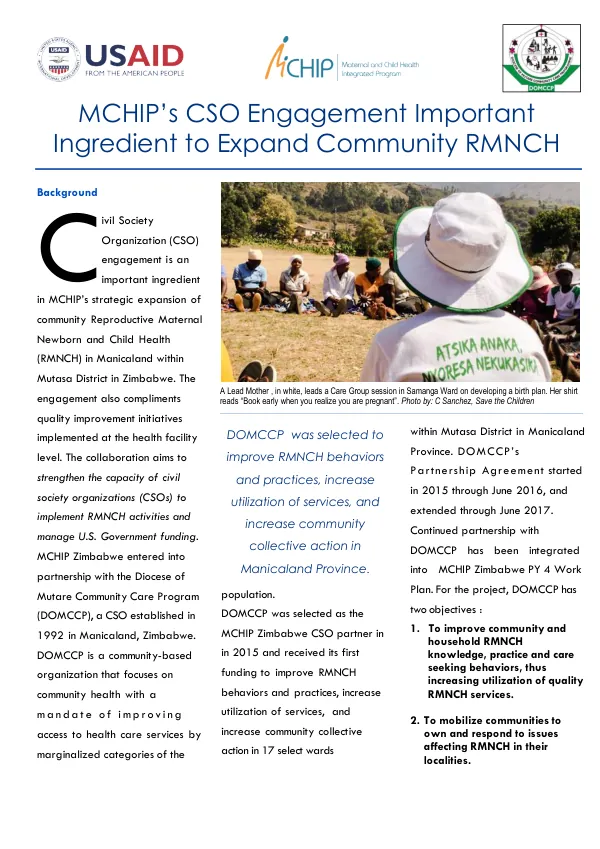
This collaboration aims to strengthen the capacity of CSOs to implement RMNCH activities and manage U.S. Government funding. MCHIP Zimbabwe partnered with the Diocese of Mutare Community Care Program (DOMCCP), a CSO established in 1992 in Manicaland, Zimbabwe. DOMCCP is a community-based organization focused on community health, with a mandate to improve access to healthcare services by marginalized categories. DOMCCP was selected to improve RMNCH behaviors and practices, increase utilization of services, and increase community collective action in Manicaland Province within Mutasa District. The partnership agreement between MCHIP Zimbabwe and DOMCCP began in 2015 and extended through June 2017. Continued partnership with DOMCCP has been integrated into MCHIP Zimbabwe's PY 4 Work Plan. DOMCCP has two objectives: to improve community and household RMNCH knowledge, practice, and care-seeking behaviors, thus increasing utilization of quality RMNCH services, and to mobilize communities to own and respond to issues affecting RMNCH in their localities. DOMCCP has advanced the Care Group Model for bi-monthly community RMNCH dialogue and practice, reaching 8,377 families. The project has revitalized family meetings in 12 communities and established new Care Groups in 2 communities. DOMCCP has also strengthened RMNCH skills of 506 Lead Mothers and 134 Lead Fathers. MCHIP's support to DOMCCP focuses on building their capacity to improve community and household RMNCH knowledge, practice, and care-seeking behaviors, engage community and healthcare facilities in defining and working in partnership to improve service quality, stimulate demand and increase utilization of quality RMNCH services, improve organizational leadership to design, plan, implement, monitor, and evaluate MNCH-related programming at the community level, and improve collaboration with MOHCC partners. DOMCCP has achieved several milestones, including applying community empowering approaches to build capacity of 17 Health Centre Committees and Family Health Groups to explore, plan, act, and evaluate together for improved RMNCH, covering a population of 74,682. Capacitated communities have been able to address RMNCH challenges and mobilize for resources as they take action for change. DOMCCP has also developed, pre-tested, and integrated the use of Family Health Counseling Cards and Family Health Booklets that integrate male involvement in RMNCH. Additionally, DOMCCP has addressed the underlying determinants of poor RMNCH practice by supporting social/normative change related to SGBV, religious objectors (Apostolic), early marriages, integration of TBAs as non-delivery, and male engagement.