JSI RESEARCH & TRAINING INSTITUTE, INC
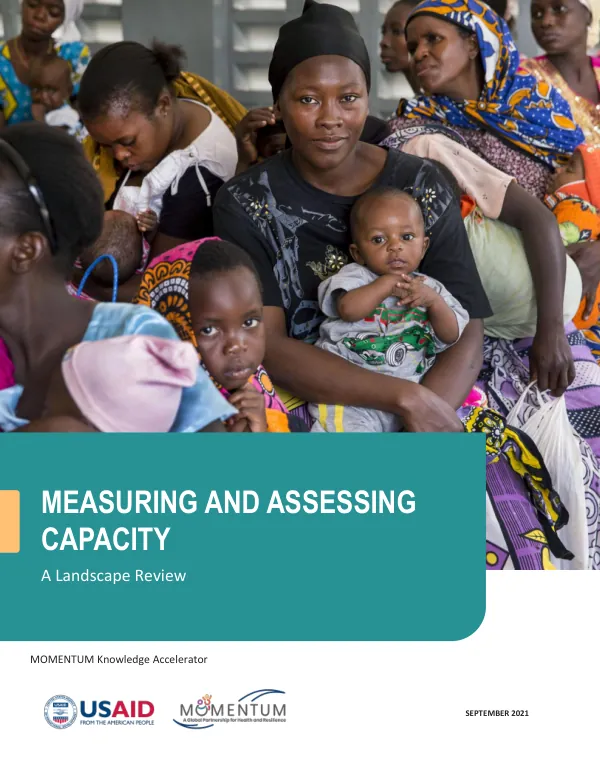
Measuring and Assessing Capacity: A Landscape Review
Capacity development is a critical component of improving maternal, newborn, and child health services.
2021 · 62 pages
Sign in to readA free account is required to download.
Abstract
The MOMENTUM Knowledge Accelerator, a program funded by the U.S. Agency for International Development (USAID), aims to accelerate improvements in health services through capacity strengthening. A landscape review was conducted to support MOMENTUM partners in introducing, delivering, scaling up, and sustaining high-quality health services through sound capacity measurement. The review highlights the limitations of existing capacity measurement tools, which often focus on organizations and neglect other units of analysis, such as systems or networks, that significantly influence health outcomes. These tools also rely heavily on self-assessment and make limited use of evidence. Furthermore, they tend to focus on latent capacity rather than performance and rarely provide information on the underlying determinants of performance. A framework for capacity strengthening, assessment, and measurement is proposed, which emphasizes the importance of understanding the complex relationships between capacity, performance, and outcomes. The framework recognizes that capacity development is a dynamic and iterative process that requires ongoing assessment and measurement. The review identifies various capacity assessment tools, each with its strengths and limitations. These tools include the Organizational Capacity Assessment (OCA) tool, the Capacity 2.0 presentation, and the Performance Indicator Reference Sheets (PIRS). The review highlights the importance of selecting the most appropriate tool for a given context and purpose. The study also examines the utility of capacity tools by health sector capacity level, perceived level of complexity, and resilience capacity. The results suggest that capacity tools are more effective in contexts with higher health sector capacity levels and lower perceived levels of complexity. However, the study notes that capacity tools can be adapted for use in contexts with lower health sector capacity levels and higher perceived levels of complexity. The review concludes that capacity development is a critical component of improving health outcomes, and that sound capacity measurement is essential for introducing, delivering, scaling up, and sustaining high-quality health services. The study recommends that MOMENTUM partners prioritize capacity development and measurement, and that they select the most appropriate capacity assessment tools for their context and purpose. The study's findings are based on a comprehensive review of existing literature and data, as well as interviews with key stakeholders, including USAID officials, MOMENTUM partners, and experts in the field of capacity development. The study's recommendations are intended to support MOMENTUM partners in their efforts to improve health outcomes through capacity strengthening and measurement. The study's methodology involved a comprehensive review of existing literature and data, as well as interviews with key stakeholders. The review of literature included a search of peer-reviewed journals, reports, and other publications related to capacity development and measurement. The interviews with stakeholders were conducted to gather information on their experiences and perspectives on capacity development and measurement. The study's results are presented in a series of tables and figures, which provide a visual representation of the study's findings. The tables present data on the utility of capacity tools by health sector capacity level, perceived level of complexity, and resilience capacity. The figures illustrate the complex relationships between capacity, performance, and outcomes. The study's conclusions are based on a comprehensive analysis of the study's findings, and are intended to provide guidance for MOMENTUM partners on capacity development and measurement. The study's recommendations are intended to support MOMENTUM partners in their efforts to improve health outcomes through capacity strengthening and measurement.
Related documents